
Medium vs Substack: Who Really Lets You Own Your Email List?
Some surprising facts about each platform that may change your mind.

In This Post:
Substack vs Medium: List Ownership
The Money Question: How Writers Get Paid
Should You Use Medium at All?
The Bottom Line
One of the most important assets an author can build is an email list. Unlike social media followers, your email subscribers belong to you—or at least they should. That’s why it’s worth taking a hard look at how different platforms handle subscriber data, especially now that Medium has shifted its policies.
RELATED: Writers: Your Content Isn’t Safe Unless You Own Your Platform
Substack: List Ownership from Day One
Launch year: 2017
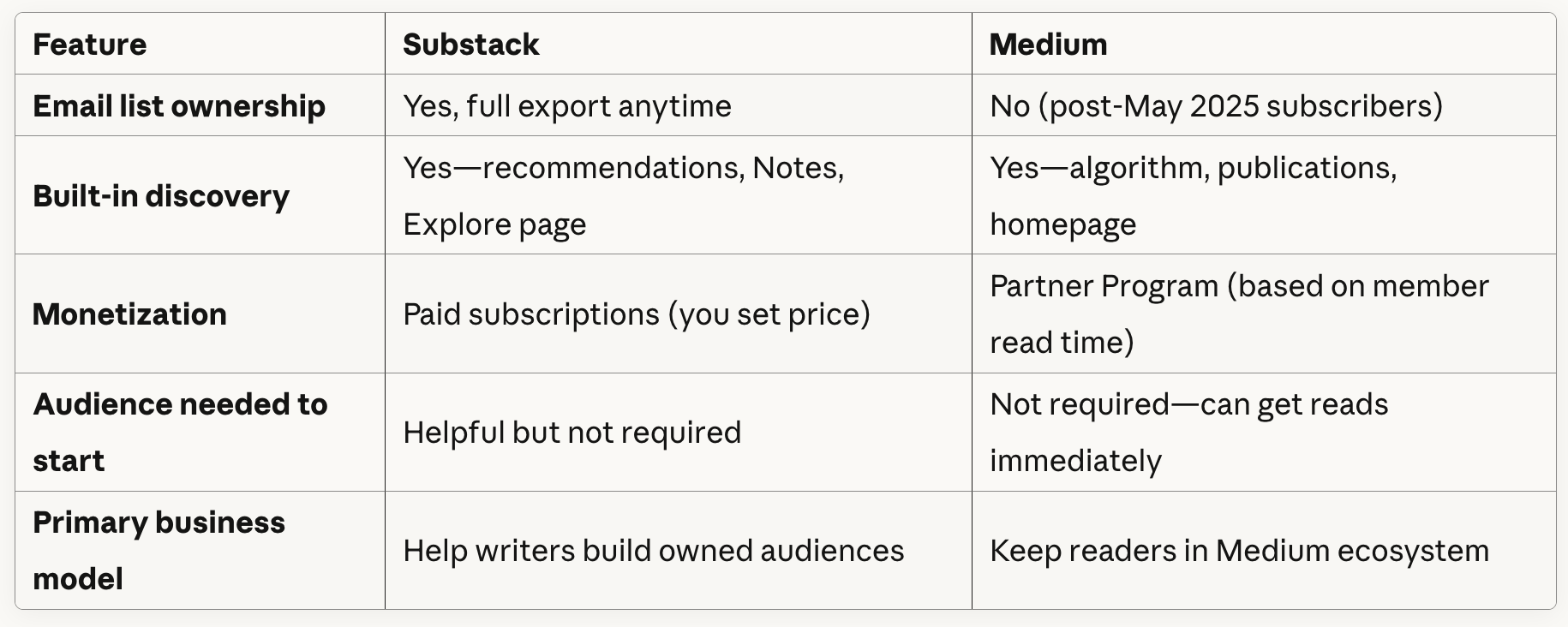
Policy: Writers have always owned their email lists. Substack makes it easy to export subscriber emails at any time.
Why it matters: If you decide to leave Substack, you can take every reader with you—no hostage situation. This is core to their business model and hasn’t changed.
Medium: From Sharing to Withholding
Early years: Medium was a reading platform first, not a newsletter service. When it added newsletters and email subscriptions (around 2020), writers could collect subscriber addresses and even export them.
The shift: In May 2025, Medium quietly changed the rules. Writers can no longer see or export new subscriber emails collected through the in-app “notify me by email” flow. You can still export older, “legacy” subscriber lists you built before the change—but anyone who subscribes after May 2025 is hidden behind Medium’s wall.
Why it matters: That means you don’t truly own your list anymore. Medium controls access, and your ability to connect directly with readers is limited to their system.
Comparing the Platforms
The Money Question: How Writers Get Paid
The way these platforms handle money is fundamentally different—and it affects how you build your author business.
Medium’s Partner Program: Passive Income Without Subscribers
Medium pays writers based on member reading time. Here’s how it works:
Readers pay Medium $5/month (or $50/year) for unlimited access to all stories
Medium divides that money among writers based on how much time paying members spend reading their work
You don’t need subscribers or followers—just engaging content that keeps people reading
Payment can range from a few dollars to thousands per month, depending on views and read time
Pros:
Earn money immediately, even as a beginner
No need to ask readers to pay you directly
Passive income—write once, earn as long as people keep reading
Lower barrier to entry for monetization
Cons:
Income fluctuates based on Medium’s algorithm and what they surface
You’re competing with every other writer on the platform for reader attention
Medium controls the payment structure and can change it anytime
No direct relationship with the readers paying for your work
Substack’s Subscription Model: Direct Reader Support
Substack lets writers charge readers directly through subscriptions:
You set your own price (typically $5-10/month or $50-80/year)
Substack takes 10% + payment processing fees (roughly 13% total)
You keep 87% of subscription revenue
You can offer free newsletters, paid-only content, or a mix
Pros:
Direct relationship with paying readers—you know who they are
Predictable recurring income (if you keep subscribers happy)
You set your own pricing and value proposition
Higher per-reader revenue potential than Medium
Cons:
Harder to convince readers to pay for your specific newsletter vs. Medium’s all-you-can-read model
Need to deliver consistent value to retain paid subscribers
Takes longer to build paid subscribers from scratch
You’re responsible for keeping readers engaged

The Hybrid Reality
Some writers use both platforms—particularly prescriptive nonfiction writers who can repurpose content:
Medium for discovery + Partner Program income while building an audience
Substack for owned list + subscription income from dedicated readers
Why this works well for business/prescriptive nonfiction:
Articles and essays repurpose easily between platforms
Topics (how-to, business, tech, productivity) work well in both formats
Medium’s audience and algorithm favor these practical, broadly-appealing pieces
Shorter, punchier content performs well in Medium’s Partner Program
For creative nonfiction, the choice is often more binary:
Medium may help with initial discovery, but the intimate, ongoing reader relationship that sustains these genres typically lives better on Substack where you own the connection. Here’s why:
These are often more personal, contemplative narratives that build slower, deeper reader relationships
Readers want to follow you and your journey, not just consume content
Cross-posting the same memoir essay to both platforms can feel awkward or spammy
Medium’s algorithm favors scrollable content with lots of subheadings over slower, more immersive, reflective work
The direct relationship with readers matters more for these intimate genres
The key insight: Medium pays you for attention. Substack pays you for loyalty.
Which model fits your goals?
If you’re starting out and need immediate feedback (and some money), Medium makes sense. If you’re building a long-term author business where readers will buy your books and support your work directly, Substack’s owned-list model is worth the harder climb.
The catch: Medium’s Partner Program income can feel addictive—it’s easier money than building a paid Substack. But you’re being paid with reach you don’t own. Medium can change the algorithm, payment structure, or visibility at any time.
With Substack, if you have 1,000 paid subscribers at $5/month, that’s $4,350/month in predictable income that travels with you wherever you go. With Medium, if the algorithm shifts or policies change, your income can vanish overnight.Why This Change Matters for Authors
If you’re building a writing career, email is your lifeline. It’s the one channel you control, immune to shifting algorithms and platform shutdowns. Giving that away means your future is at the mercy of a platform’s business decisions.
Medium’s decision is a clear signal: their priority is keeping readers inside their ecosystem, not giving authors long-term independence. Substack, on the other hand, still treats email list ownership as non-negotiable.
But Should You Use Medium at All?
Here’s where it gets nuanced. Medium does offer real advantages—the question is whether they outweigh the loss of list ownership, and the answer depends on where you are in your author journey (and how much energy you have to experiment with both platforms).
For Authors Starting Out (Building from Zero)
Medium’s advantages:
Immediate readership without needing an existing audience
Algorithm can surface your work to new readers
Earn money through the Partner Program based on reading time, no subscribers required
Test whether your writing resonates before investing in platform building
The catch: You’re building on rented land. Those readers aren’t really yours.
Best strategy: Use Medium for discovery and validation, but always funnel readers to an owned platform from day one. Include links in your bio and CTAs in your articles pointing to your website or Substack signup. Think of Medium as a storefront that drives people to your owned email list.
For Established Writers Already on Medium (Have Momentum)
Medium’s advantages:
You already have an audience there—followers, articles ranking in search, established presence
Partner Program income is flowing
Visibility and credibility from being on the platform
The problem: Post-May 2025, new subscribers are locked behind Medium’s wall. You can’t take them with you if things change.
Best strategy: Stay on Medium to maintain your momentum and visibility, BUT aggressively drive traffic to your owned email list through:
Bio links to your website/Substack
Strong CTAs in every article pointing to newsletter signup
Cross-posting the same content to both Medium and your owned platform
Treating Medium as a marketing channel, not your home base
The bigger your Medium audience, the more urgent it is to extract those readers to a platform you control—because you can no longer count on Medium to let you keep them long-term.

The Bottom Line
For authors serious about reaching readers directly: Build your list on a platform that lets you export and control it. That’s your insurance policy in a changing publishing landscape. For creative nonfiction authors, this will probably be Substack. For prescriptive, Medium, or Medium + Substack.
Medium can be valuable at different stages of your career—as a discovery tool when starting out, or as a visibility engine when established. But it should never be your only platform.
You can use Medium’s audience to build your audience. Always be moving readers from Medium to your owned email list. Because the next policy change isn’t a matter of if, it’s a matter of when.
Look at Substack as a social media platform, blogging platform, beta publishing platform, even a website. Really, it may be all you really need right now. It’s a lot to think about. But it’s worth your time because the sooner you start growing your platform, the better.
What do you use to share stories and build your email list? Are you on Medium, Substack, or both? Drop a comment and let me know.
~Carla
PS: In the publishing community on the Writing & Publishing Circle we put a lot of emphasis on comparable analysis of your book and market. That way, you can figure out where authors like you are hanging out and talking with their readers, who are also your potential readers. Here’s your free invite link. Join us, introduce yourself, ask questions, join a writing group, take a look around.