
Present Tense: Let Art Disturb You
On choosing disturbance over comfort, in art and in life

Pardon the interruption of the China Road Motorcycle Diaries for one of my occasional present tense interludes: stories or essays from the moment. I hope you enjoy this observation about art I was compelled to write after visiting the Portland Art Museum. Don’t worry, more of the China Road Motorcycle Diaries is coming up soon!
The art that actually changes you—the stuff that crawls under your skin and messes up your equilibrium—is almost never the pleasant kind. It’s the piece you don’t like on first contact. The one you would never hang on your wall. The book that unsettles you. The music that vibrates at a frequency you weren’t prepared to hear. That’s what I found at the Portland Art Museum a couple of days after Thanksgiving, though I didn’t know I was looking for it.
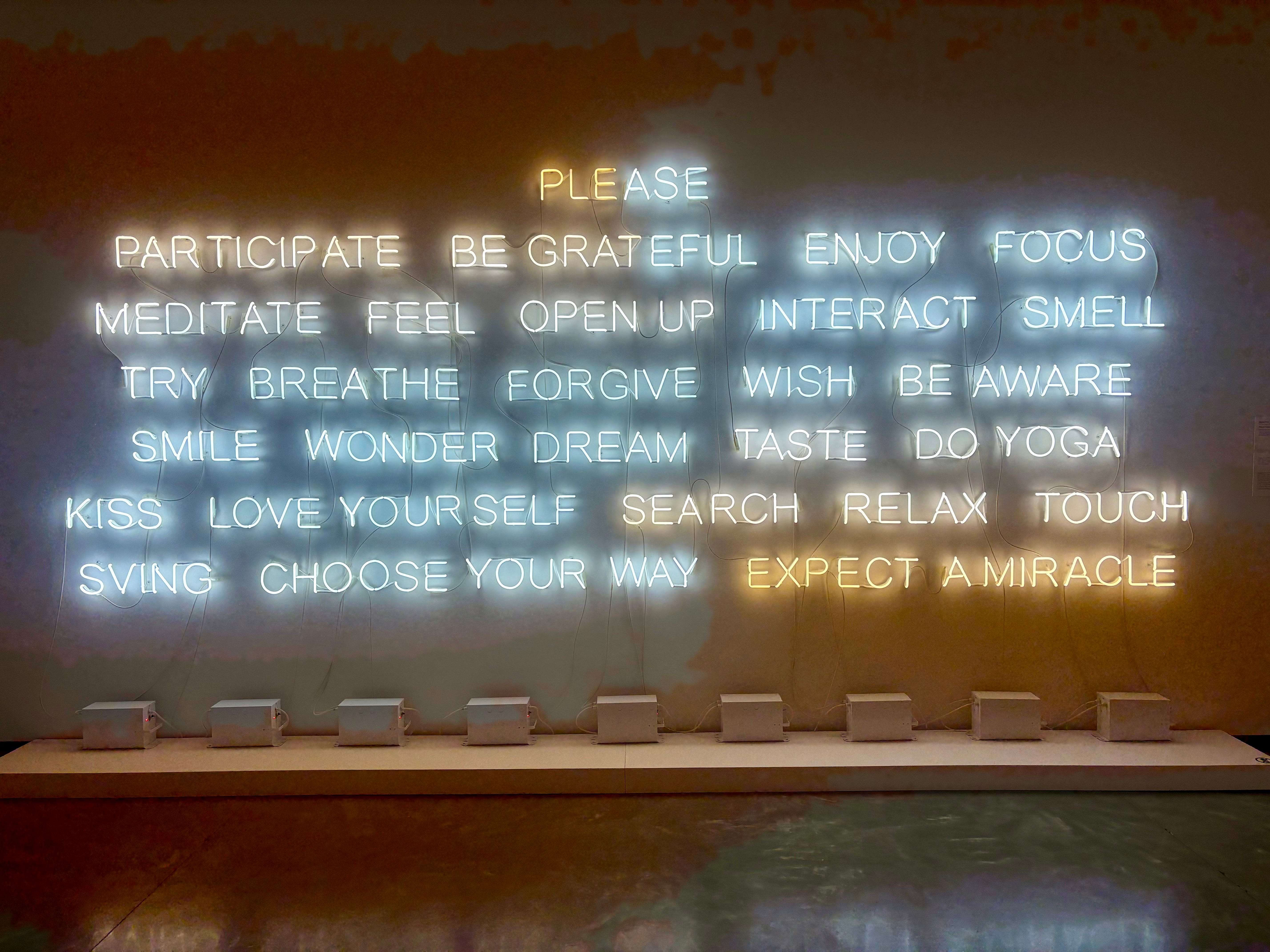
I’d traveled to Portland to spend the holiday with my sister and her family, and it was a lazy, drizzly, post-holiday afternoon. If you’d asked me why I wanted to go, I probably would have said something about relaxing, restless from being inside too long, just wanting to take a stroll through the new Portland Art Museum, which re-opened last year after a 100,000 square-foot upgrade. But subconsciously I think I knew I needed a mind shift. My equilibrium was off. I was seeking balance, or maybe I was seeking to tip further off-balance in a useful direction.
I was still reeling from the message our president had spewed out to the entire country—a Thanksgiving greeting that wished happiness to everyone “except those that hate, steal, murder, and destroy everything America stands for—you won’t be here for long.” A shocking holiday message directed at millions of Americans.
Perhaps I needed a widened perspective, exposure to ideas that challenged rather than confirmed, a visual reset button as an antidote to a country contracting into itself, closing doors that had taken generations to open. And I got it big time, walking into Rick Bartow’s world.
His work stopped me cold. The first painting that greeted us was “Crow, Song, Bear” (2014). I walked toward the painting slowly, trying to understand what had drawn me besides the sheer force of color. It felt like encountering a new language I was suddenly desperate to learn.
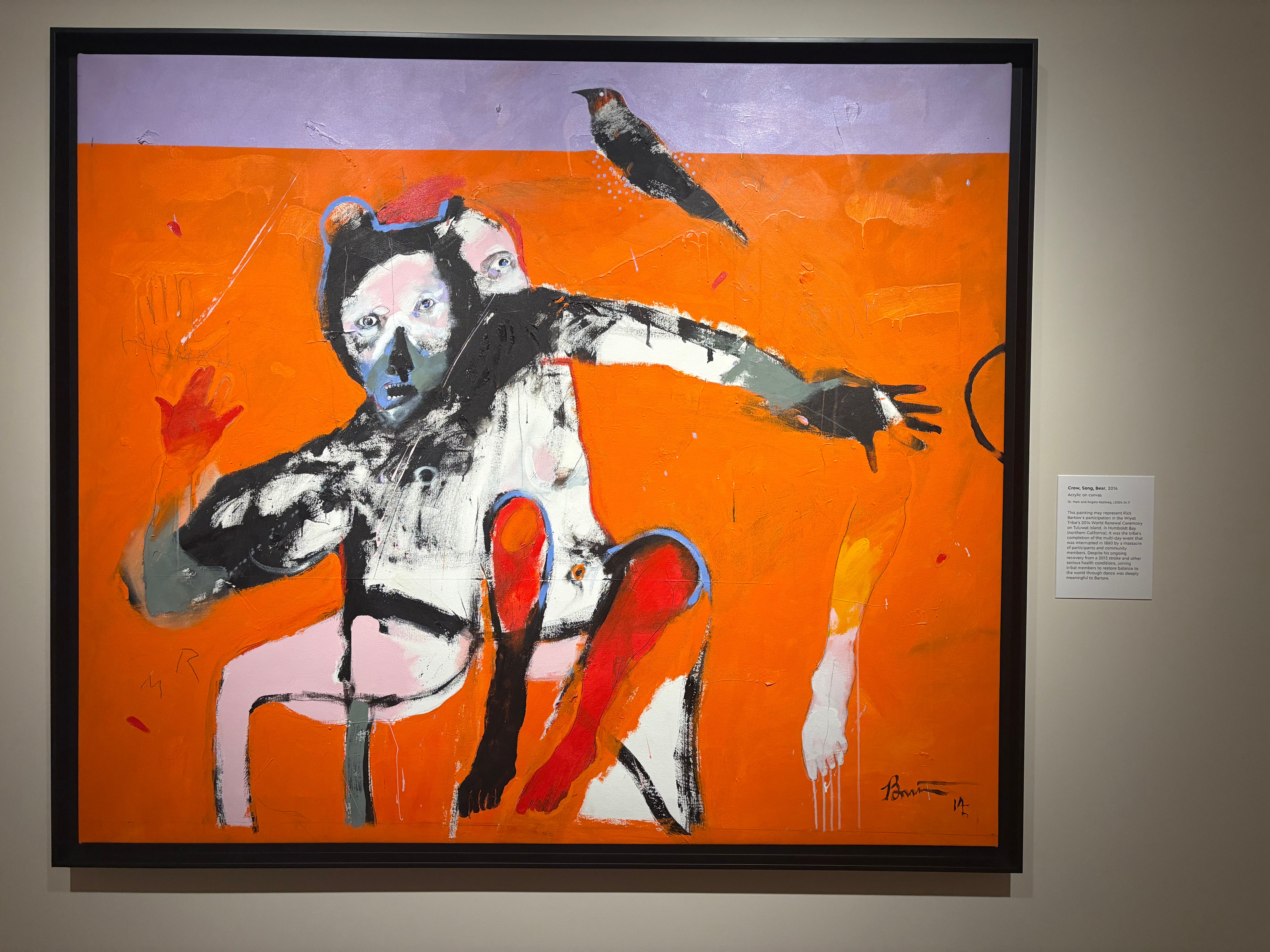
The painting’s vivid orange backdrop immediately commands attention, an aggressive vibrancy that refuses to let viewers pass by. That intensity pulled me forward to examine the transformational ambiguity at its heart: the bear-human hybrid caught mid-metamorphosis, the multiple faces layering and emerging, the red hand pressed flat as if the figure is simultaneously pushing through and being absorbed by that luminous field. The crow overhead watches this threshold moment, this unstable instant where boundaries dissolve. What Bartow captures is the disorienting vertigo of becoming—not the before or after, but the uncomfortable, electric present of change itself.
On the other side of the wall hung two paintings in a completely different mood but equally uncanny. Thought provoking.
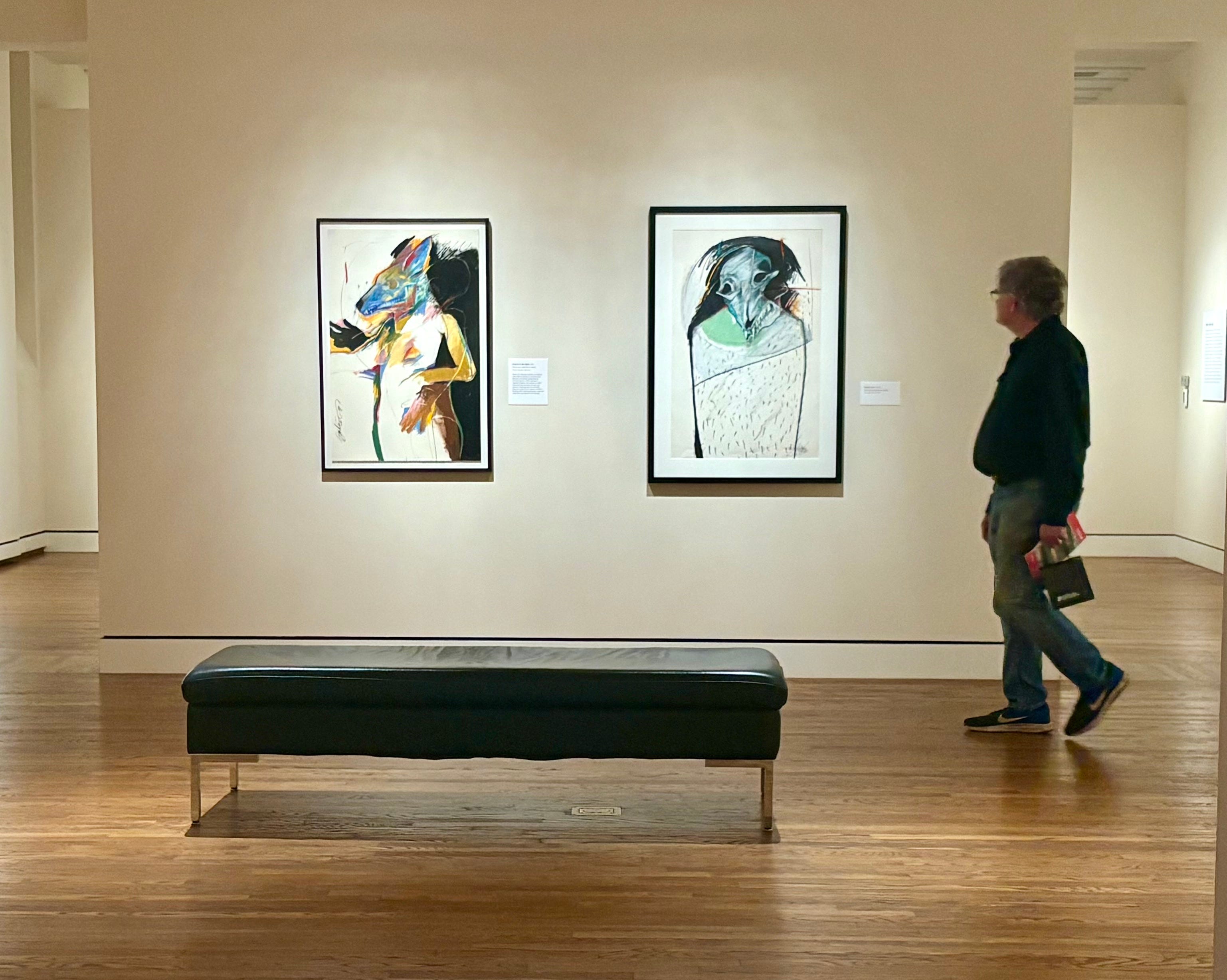
Bartow (1946-2016) was a member of the Wiyot, a Native American tribe from Northern California, and a Vietnam veteran. Much of his work sits inside an intersection of human, animal, trauma, resilience, and spiritual permeability. You can feel it. His canvases insist that the boundary we like to draw between animal and human is much thinner than we pretend. I kept thinking: this is what I mean by “disturbing in a constructive way.” Bartow’s art doesn’t just show you an animal spirit; it shows you the parts of yourself that remain half-wild, half-spiritual, half-wounded, half-transformed. There’s no polite separation.
And that disturbance—being forced to confront your own in-between-ness, your own ambiguity—was energizing. I welcomed it. I could feel my spirit moving.
In a corner of the exhibition, a video of Bartow performing music with his band was looping. A reminder that he wasn’t just a painter who also played; music ran parallel to the art, braided through his life the way his animal-human figures braid identities on the canvas. He had been drawing since childhood, but the guitar came in during high school, and by the time he was in Vietnam he was literally playing in military hospitals for wounded soldiers. The Army even gave him a Bronze Star for that.
I didn’t know anything about him and the music aspect of his art made the paintings feel different—not softer, but more dimensional. The urgency in his lines suddenly had a rhythm to it, like improvisation. The fragmented faces and animal forms, the crows perched on shoulders, the eyes that look both startled and ancient—they carry that same pulse you can hear in someone trying to play their way out of grief.
Yoshida Chizuko: The Sound Inside Color
When we stepped into the Yoshida Chizuko exhibition, everything suddenly clicked. I didn’t long for the old masters or even the impressionists so beloved to me most of my life. Museums can serve two purposes: they can offer comfort in beauty you already understand, or they can disturb you with what you don’t. I’ve needed both at different times. That day, I needed disturbance.
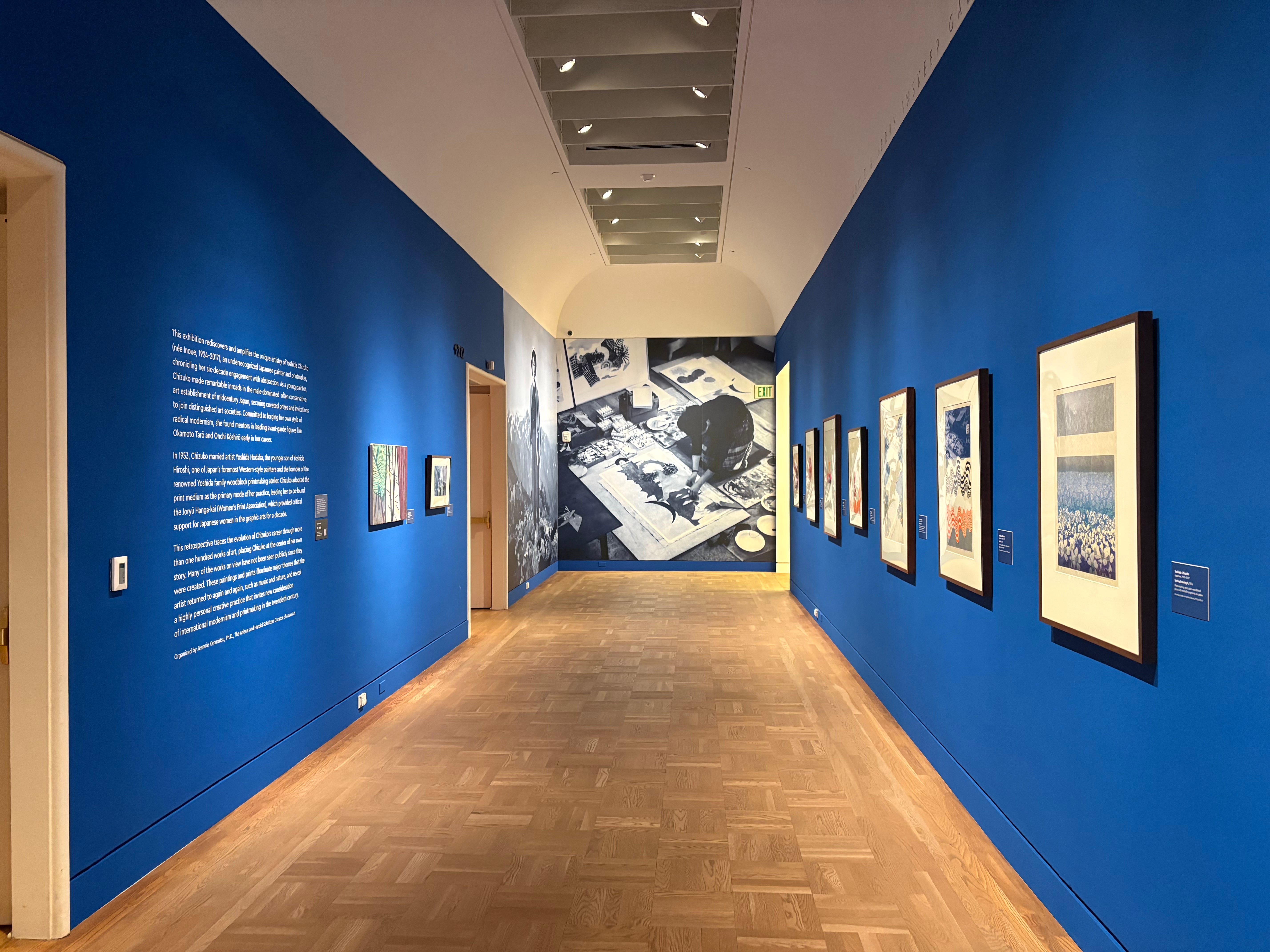
My sister and I hung out there for a long time, enjoying the layers of the artist’s compositions, reading all the plaques, and listening to the audio whenever QR codes were offered. We marveled at the disturbance, energy, process, pattern, and performance of every piece. My favorites were on a cobalt-blue wall—two of her 1956 prints: “Mambo No. 1” and “Mambo No. 2.”
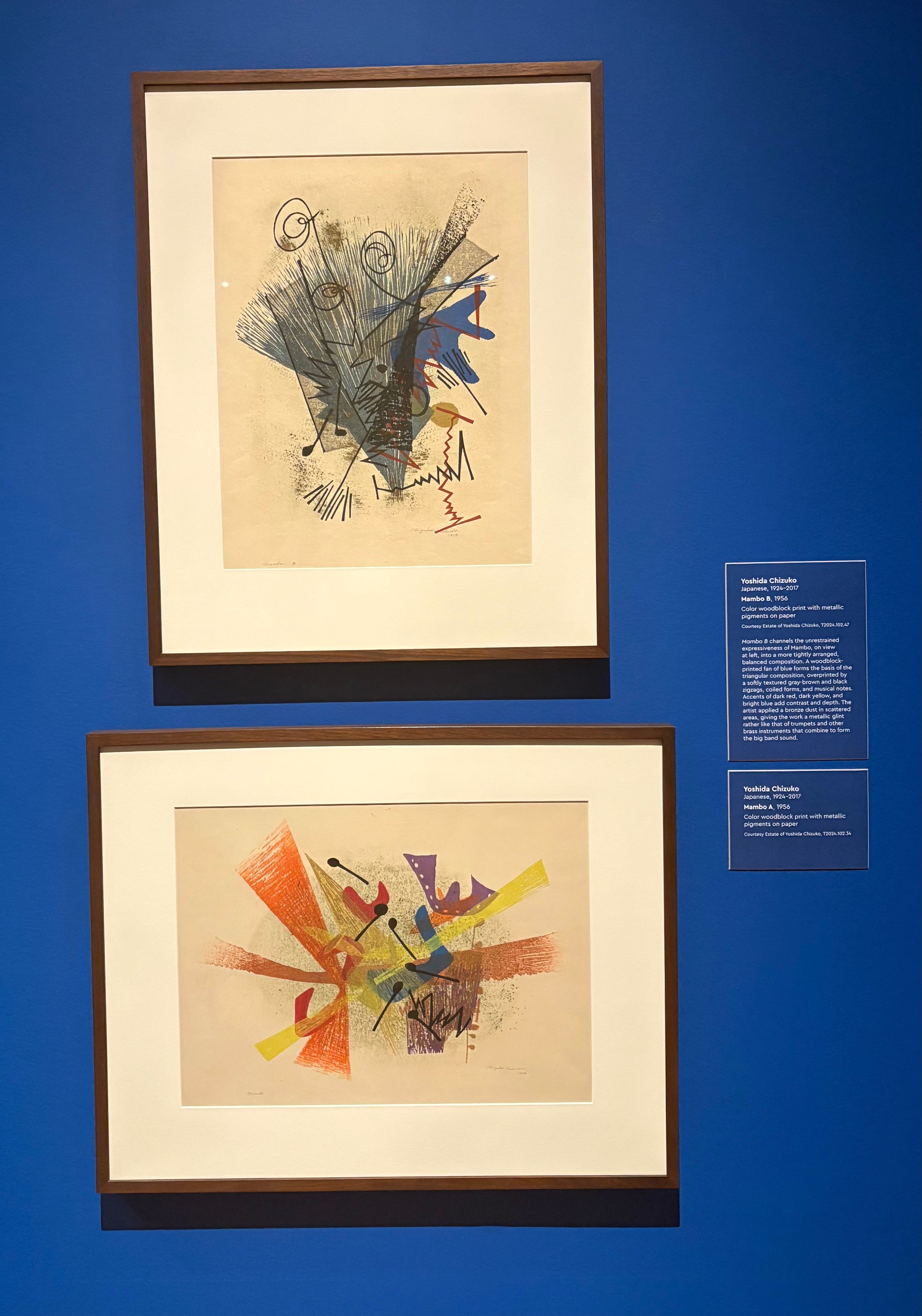
These are electric. Bright oranges. Yellow slices. Purple sparks. Lines like musical staves gone rogue. Shapes that behave like sound hitting the air at different angles. And the wall label confirmed exactly what I thought I was seeing: “Mambo is Chizuko Yoshida’s interpretation of a South American–influenced jazz style that became popular in Japan in the 1950s. These prints capture the rhythms and movements of the music.”
So my brain hadn’t invented the musical reference; it was built into the work.
Chizuko listened to music and tried to translate what she heard into color and shape. She was literally making a visual score. I stood there trying to figure out how she got her colors so bright. It’s printmaking—pigment and metallic inks on paper—and yet the thing seemed to buzz with a frequency that felt louder than the room. It’s not that the prints depict music; it’s that they behave like it.
This made me think of something I’d seen earlier in one of the photography rooms. A small placard beside an Ansel Adams print reminded me that Adams was an accomplished classical pianist before he became a photographer. The musical training never left him; in fact, it structured his whole sense of what a photograph was. He said: “The negative is the equivalent of the composer’s score, and the print the performance.”
Meaning, the decisive moment with the shutter click is just the beginning. The real art is in the printing, the layering, the interpreting, the printing again, adjusting contrast, manipulating shadow and highlight like you would voice or volume. The finished thing isn’t the point—the process is. The performance is. Chizuko seemed to have understood this: the way the print becomes a performance of something behind it. The way the process and the result refract each other.
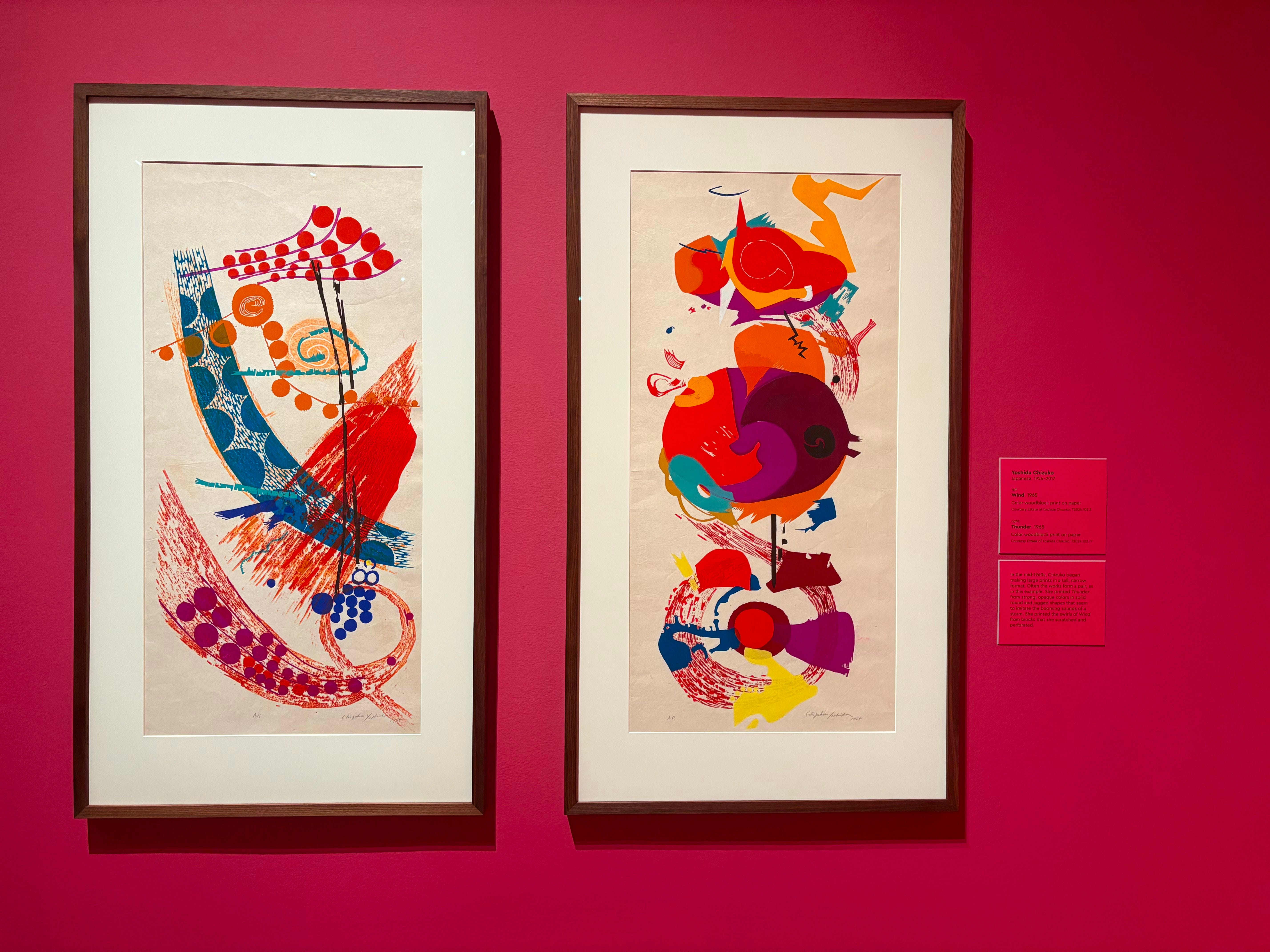
This disturbed me too, in the best way—because it challenged my idea of what printmaking is supposed to do. I realized I’d been limiting myself. I’d been thinking too small about color, texture, mark-making, and the way visual work can carry vibration. It made me want to rush home and paint my walls in some unruly color and then scrape and sand and glue and draw into it until it held some life. Not a soothing life—an awake life.
The Bathroom
Before moving to the next exhibition we passed the restroom. The “All User” sign was a simple icon of a toilet, a piece of art, itself. Where I live, as in Portland, this is unremarkable. But I stood there for a minute, waiting for my sister at the water fountain, and felt the weight of knowing that somewhere, someone is terrified of this door. That legislators spend hours debating who can use which bathroom while actual human beings are being told they “won’t be here for long.” It wasn’t that long ago that bathrooms were segregated into white and non-white. The fear never really changes—just the target.
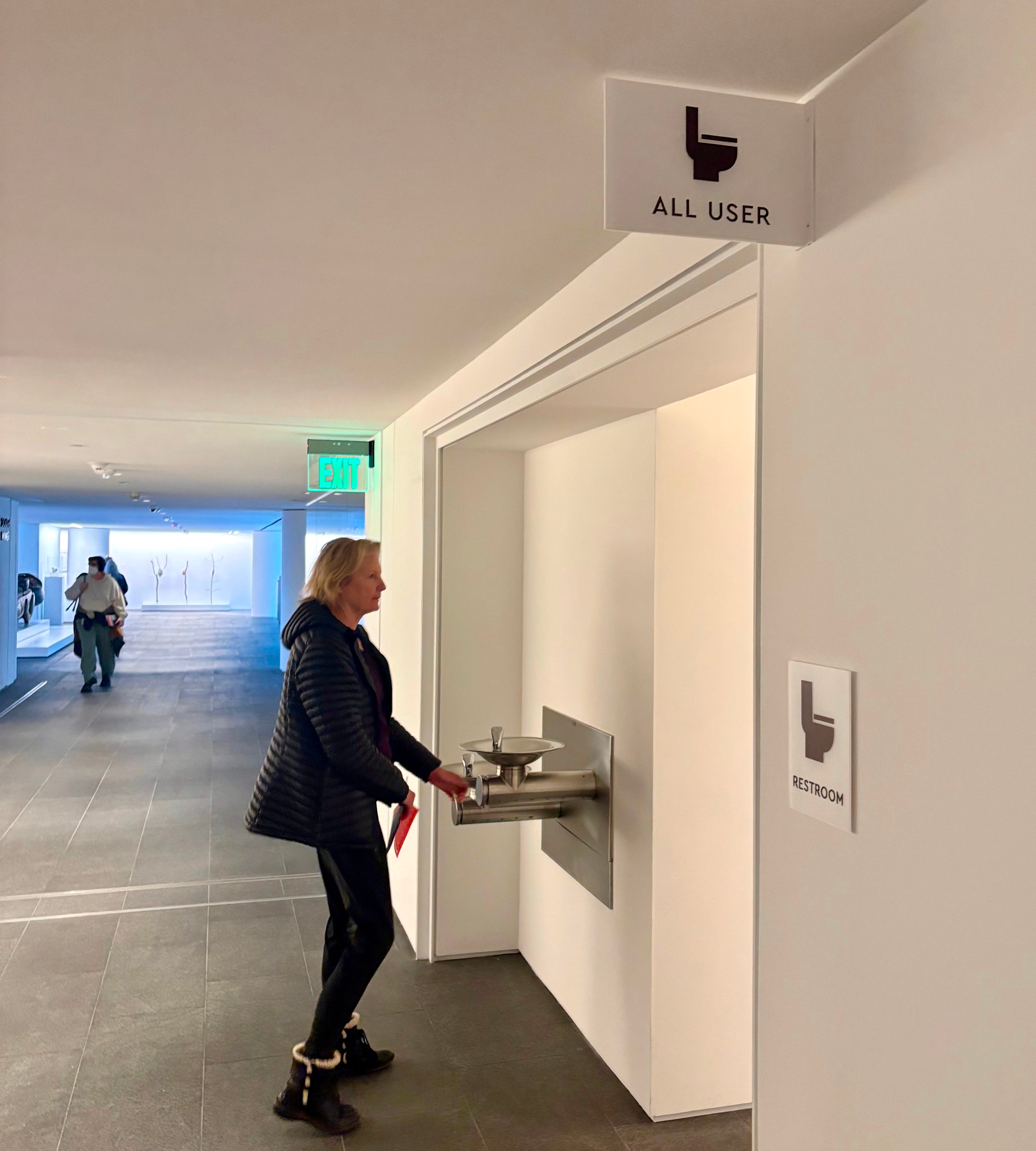
The museum is full of work that questions the very idea of fixed identity—work that celebrates cross-cultural exchange, that treats difference and foreignness as essential rather than threatening. These works are decades and centuries old, and modern too, yet the world outside still fixates on bathroom signs as if rigid categories are the only thing holding civilization together.
Jiseon Lee Isbara: Learning and Erasure
A little later, I almost walked past a glass case holding a book—open and fanned out like an explosion of pages, with long ribbons trailing downward like roots or tendrils or nerves.
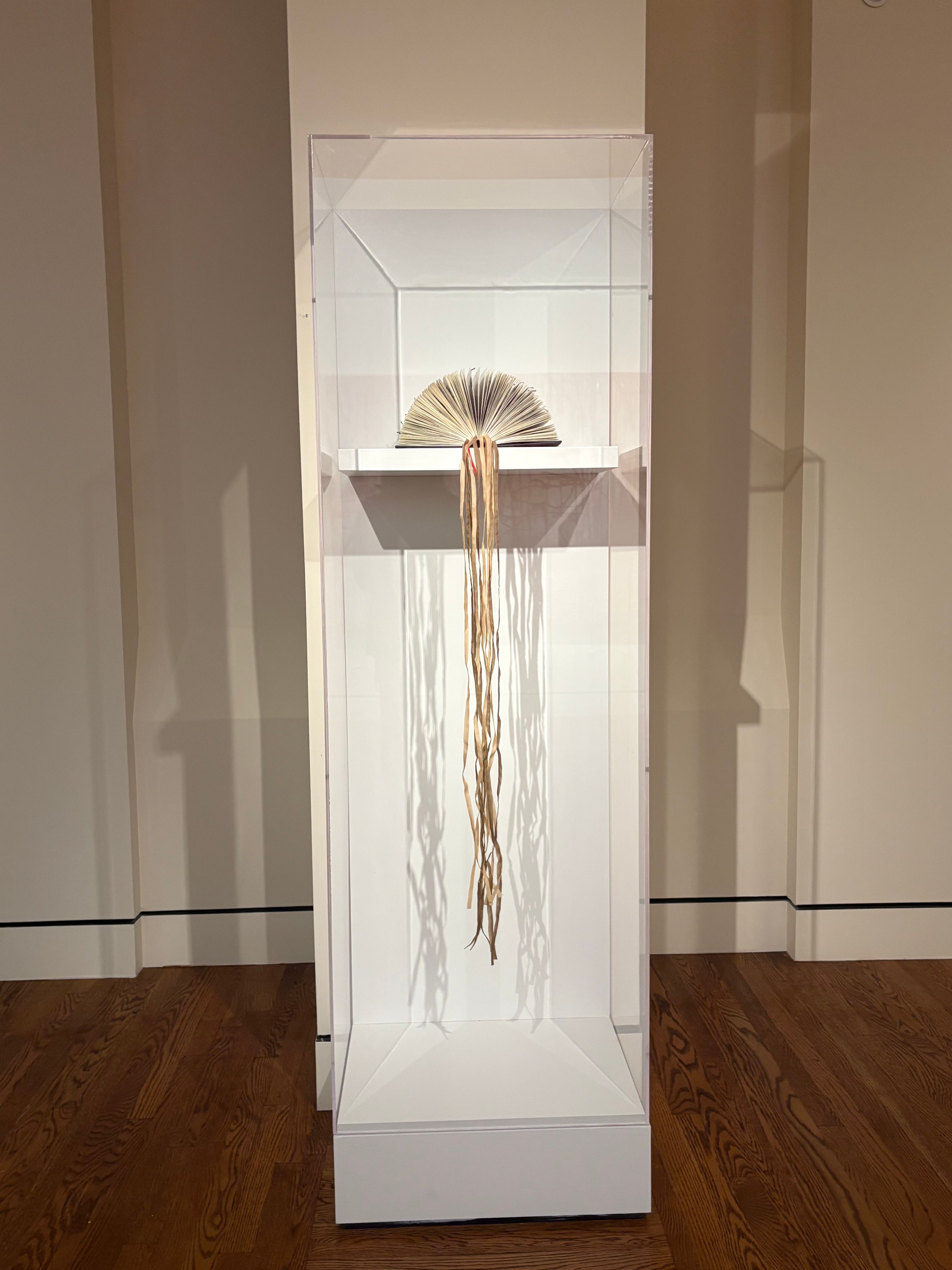
This was Jiseon Lee Isbara’s Jane Eyre from her series Top Ten Books to Read Before You Die. A real book, opened wide, pages stretched and fanned, with long ribbon markers dangling like tendrils. But the real shock was the stitching. Thread sewn through every word she didn’t know while reading these classic novels as a foreign-born U.S. citizen learning English. On one side, the stitches are the exact record of not-knowing, of stopping, of struggling. On the reverse, they’re arbitrary erasure. The same action becomes learning from one angle, censorship from the other.
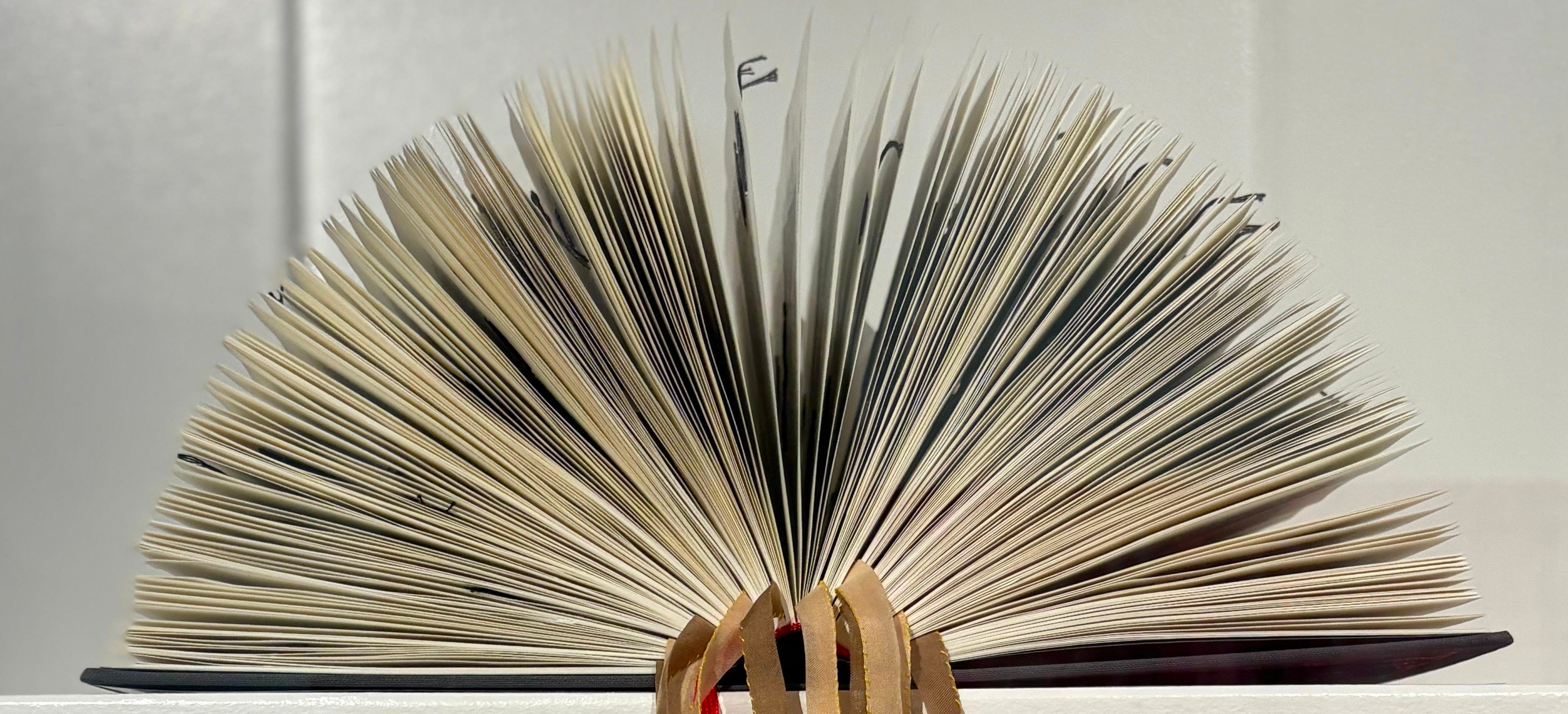
That struck me: the same action can be learning from one side and erasure from the other. Assimilation is like that. So is censorship. So is misunderstanding.
Standing there looking at Isbara’s Jane Eyre, I kept thinking about the panic over books now—the way certain people insist that stories they don’t understand are too dangerous to be allowed. That novels about queer kids, or immigrants, or racial history, or gender complexity, or anything outside the majority curve, need to be pulled from shelves to “protect” children.
But protect them from what? From the feeling Isbara recorded so honestly—the moment of not knowing, of having to pause, of being humbled by unfamiliarity?
Because that’s what reading actually is: a long sequence of not-knowing, stitched together by curiosity.
And I realized how honest Isbara’s piece is about what comprehension costs. She doesn’t hide her struggle; she exposes it. She shows exactly where meaning faltered. Imagine politics that allowed that level of honesty. Imagine leaders who could say “I don’t understand this yet” or “This makes me uncomfortable but I’m willing to learn.” But we don’t. We erase. We ban. We refuse conversation. It’s the adult version of stitching over all the hard words—not to learn them, but to make sure no one else can read them either.
Gazing at that book, I felt something breathing—like understanding itself needs space, needs air, needs exposure. A book or a painting or a print cannot change you unless you are willing to be unsettled. Unless you come to it with the willingness to be wrong, to be surprised, to feel something unfamiliar.
Cross-cultural understanding has always involved this kind of discomfort. You have to let another person’s story pass through you, even when it contradicts your assumptions. You have to listen to rhythms that aren’t your own—like Yoshida Chizuko listening to South American mambo in postwar Japan, translating it into sharp color and metallic percussion on paper. That’s what cultural encounter looks like when done honestly: curiosity, absorption, adaptation. A willingness to sit inside someone else’s pulse for a while.
The Beige Problem
Which got me thinking: I’m in the process of painting my walls, considering neutral tones—beige, greige, sage—for calm, something stable and easy on the eyes. And sure, home should be comforting to some extent. My home—currently a 34-foot fifth-wheel parked on my parents property in California—does a good job of giving me both the stability and the freedom I need. High ceilings, little kitchen island, a cozy bedroom with a queen bed and a big closet, a decent sized bathroom. It’s an ideal living space for someone who has always valued going places over staying places.
I’ve always been itchy to explore, to learn new things, to see how other people live, to test myself. I’ve never been good at staying put. For me, mobility is stability. The fifth-wheel isn’t a compromise or a way station; it’s the point. It lets me stay exposed to whatever comes next. It keeps me from settling into one answer, one view, one version of how life should look.
But nothing in my home currently disturbs me in the way that Bartow or Chizuko’s work does. Nothing wakes me up.
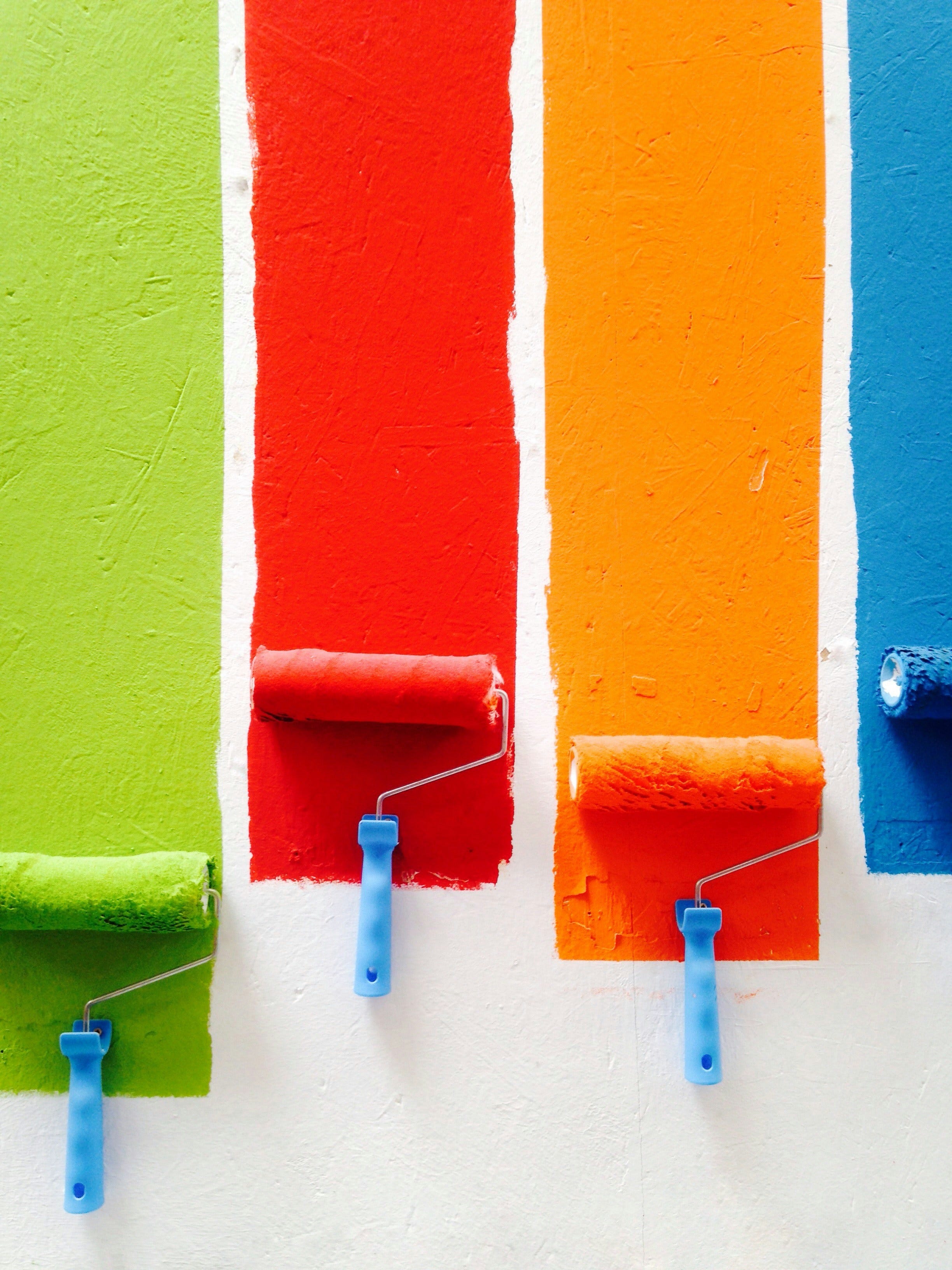
I’m rethinking the use of beige and greige and sage for not disturbing me, because they don’t ask anything of us. But I’m wondering if a home that inspires is one that pushes back a little. One that says: wake up. Be here. Pay attention. Maybe a bold turquoise wall with scraped white showing through would do that. Maybe sketching on the walls themselves might do it, too. I’ve always been drawn to drawing, but at some point I chose writing, so I’m not terribly skilled. But why not? I might hate it. I might repaint. But the point is the attempt.
Living as Performance, Not Product
I’ve lived this in my own way. Riding motorcycles across countries alone, as a woman, was not soothing or safe or beige. It disturbed people—including me. It showed readers something about what was possible. I’ve gotten emails from women (and men, too) who said my travels made them rethink their own limitations.
In 1998, riding solo through China, I got lost in remote mountains hours after dark. When I finally found shelter, it turned out to be a brothel. I stayed anyway, because my only other option was to camp beside the road in the cold and the dark.
I lived through it. Laughed about it. Learned a few things about what happens when you let yourself be that exposed, that vulnerable, that far outside the map of what you thought you knew. You don’t get to choose your comfort. You get what comes.
That’s the same energy I felt looking at Bartow’s orange morphing figure and Chizuko’s explosive Mambo prints. They weren’t trying to comfort. They were showing truths—unpredictable, electric, raw. I guess you could walk away, but why?
What Art Demands
So maybe the question isn’t “Do I like this painting?” or “Would I hang this above my couch?” or “Does this fit with my color palette?”
The real questions are: Why does it disturb me? What is being awakened? Does this make me think?
If the answer is yes, then that’s the piece you need to stand in front of longer. That’s the one that wants to change you. That’s the one worth letting in.
Art is not decoration. Art is exposure. And exposure—if you let it—is how you change.
Every time I’ve let myself be disturbed—quitting the steady corporate gig for short-term contracts, taking a job in France, moving to Baja, choosing the fifth-wheel over the apartment, leaving relationships and leaping into new ones, pointing a motorcycle toward a country I’d never seen—I’ve grown. Every time I’ve chosen beige, I’ve shrunk.
I’m thinking about turquoise walls again.
I really enjoyed reading this. I’ve spent much of my life traveling, choosing movement, exposure, and uncertainty over settling into something safe, and your reflections mirrored that truth back to me in a way that felt both affirming and challenging. I’m in the middle of finishing a painting right now that makes me uneasy—one I don’t fully understand yet—and reading this reminded me not to stand down that discomfort just to make it easier to live with. The way you describe art as exposure, not decoration, and life as performance rather than product, resonated deeply with how travel has shaped me: the moments that changed me most were never the comfortable ones. Thank you for naming disturbance as something to trust, and for bringing these ideas to the forefront with such honesty—it helped me stay with the work instead of retreating from it. Which I seem to be really good at when I want to hahaha!
Thank you Carla, for a visit to the Museum on a drizzly day, opening eyes that think they prefer the Impressionists compared to those you showed. Your elegant descriptive wordplay was art in itself!
An enjoyable and enlightening armchair travel.