Welcome to The China Road Motorcycle Diaries, an adventure memoir in progress.
In 1998, before highways webbed the country and before China’s middle class filled the roads with cars, I rode an antique sidecar motorcycle alone across northern China, over provincial borders, into unnamed villages, through dust and doubt and long stretches of silence.
I’m publishing the book here as I write and revise it, one stretch of road at a time. Free subscribers can read selected chapters and follow the journey from a distance.
Monthly subscribers ($7) read the full manuscript-in-progress, join the chat, and take part in monthly live conversations as the book takes shape.
Annual supporters ($79) receive a special digital edition of the completed manuscript and access to live and recorded conversations.
Patrons ($179) also receive a special-edition print copy of the finished book.
However you choose to be here, thank you. This story is being written in public. To receive new posts and support my work, please consider becoming a subscriber. Thank you!
Find the full table of contents here.
Chapter 13: The Wild Wild West
It’s the Wild Wild West of old Hollywood movies, except the hero is a Chinese guy riding a motorcycle up to bust the mahjong game and the saloon gal is dealing cards on an upside-down crate at the noodle stand. The town is full of farm folk. A morning rain has passed quickly. It’s lunchtime, and everyone’s just hanging out watching the traffic splash by.
Ma and Pa ride in to sell cabbages and cucumbers piled up neatly in their donkey cart with narrow wheels that dig the ruts in the road even deeper. Adolescent boys loiter around a blind curve by a huge mud hole. I see the boys before I see the mud hole and apply the brakes in a panic, realizing too late why they’re there. I don’t clear it. The sidecar wheel falls into the hole, mud flies, and the hole yanks the whole bike to the right. I overcompensate and the bike lurches left and the wheels scoop up the puddle of mud and splash it up onto my leg. It’s all I can do to regain control of my 800-pound steed. I lean hard to the right, wrestling the handlebars and manage to get it running straight down the road again. The boys clap, shout, and laugh after me as I ride on, swearing into my helmet, but more slowly now, having learned this same lesson the hard way, one more time.
Cowboy truckers take that mud hole like it’s nothing, hauling ass through town with loads of sheepskins and hay. The road through town is a high-walled canyon, squeezed like a corseted waist, without even room for a sidewalk. Their wheels spatter mud on the people and the carts and onto the dirty little storefronts.
Just before the middle of town I get stuck behind a truck hogging the entire street, his right since he’s the biggest thing on it. He swerves erratically to avoid the deepest potholes. He hauls an extremely heavy load, a neat rectangle of boxes roped down tightly with cheap plastic tarps in various shades of blue. Most drivers load their trucks casually, to put it mildly, leaving a trail of coal, bricks, chickens, propane tanks, whatever, in the road behind them. Not this one.
As the road narrows, ruts and potholes multiply, and the truck becomes a drunken dancer, sending bicyclists and pedestrians to duck and huddle into doorways for safety. Then another big blue truck lurches toward us, lighter than the one I follow, with a load of golden hay smashed into its metal bed and barely secured with rope. At the last second he slows to avoid the dangerous sway of my trucker’s tall load, but he doesn’t quite stop.
Pedestrians and bicyclists have seen this movie before and fling themselves into doorways or flatten themselves against walls. Traffic behind me skids to a stop, throwing dirt and dust motes up to glitter in the sunlight. Neither driver is willing to halt completely, and they inch past each other. I position myself to the left of my truck so I can see the driver’s face in his side-view mirror.
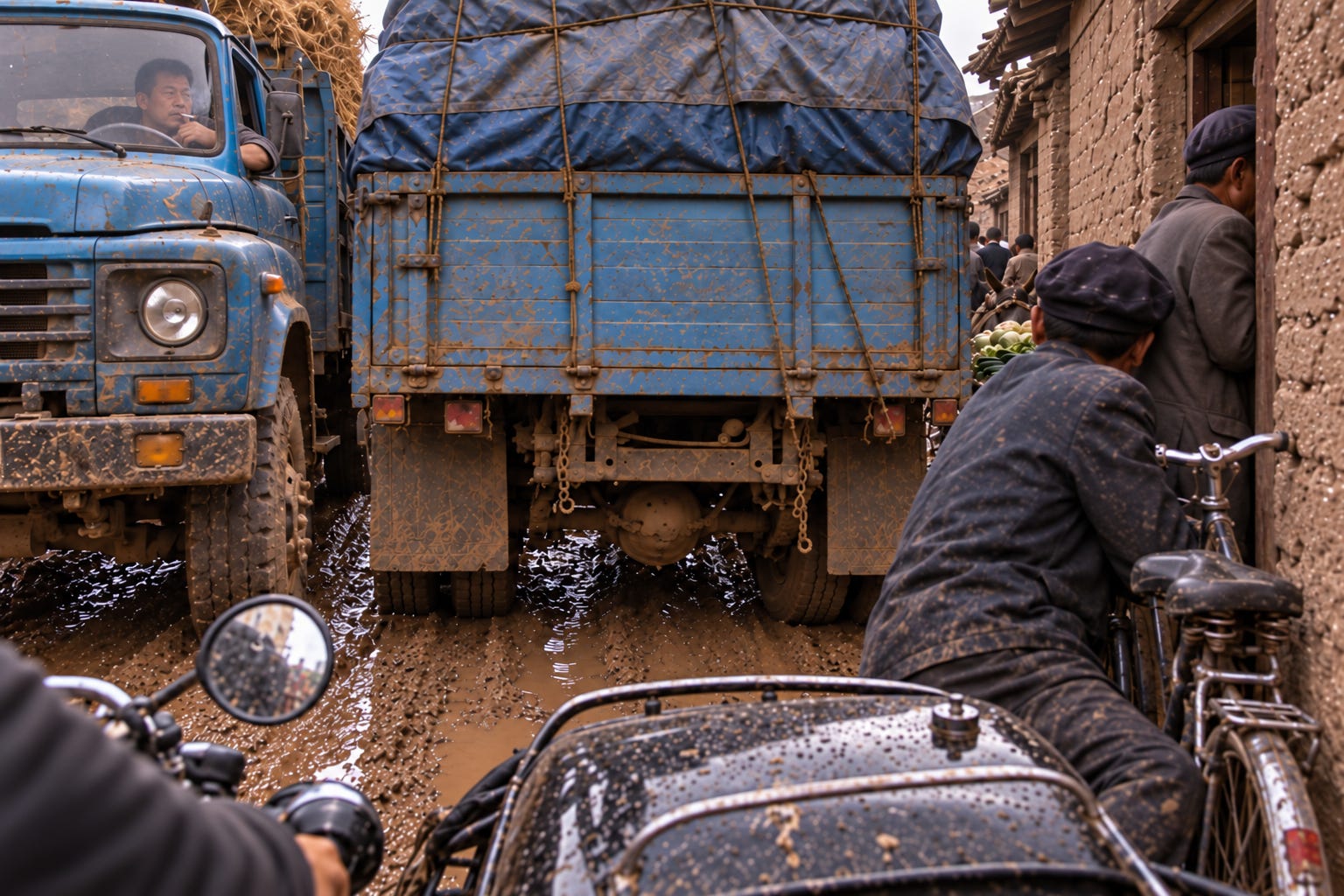
The drivers barely exchange a glance as their cabs pass each other and then the first half of their truck beds clear with only a breath between them. I feel the whole town start to sigh in relief but just then my trucker’s left front wheel hits a pothole and the whole thing swings over into the other guy’s hay bed. The metal mesh sides of each truck bed smack together and mate.
The drivers, who were coolly smoking cigarettes with their elbows out the windows, now jerk their arms in and clench their teeth around their cigarette butts. In unison, they stretch their necks outside the cab windows and turn their heads to look behind them. Every onlooker shouts instructions, hands waving, some even crawling over vehicles to get a better look. I shut off the ignition, since nothing can move. A dozen cyclists crowd behind me, smelling of sweat, cigarettes, and greasy lunches.
With their truck beds practically welded together you’d think they’d stop to discuss the situation, but the drivers continue to ignore each other. Instead, both shove their transmissions into reverse and their gas pedals to the floor. Alarmed, I start the bike as fast as I can and jam it into reverse. The bicyclists scramble in retreat, some using my sidecar as a launching pad. We all lurch into motion, but the trucks’ engines screech and their wheels spin in place as they send more dust and mud flying.
The truck beds shudder and bang and rattle. I’ve only cleared the area by about ten feet, so I look for the nearest doorway so I can launch myself into it, that is, if I have to sacrifice the motorcycle and run for my life.
When I am completely convinced that one or the other truck bed will be ripped from its weld, they come apart, unlatching like somebody pushed a magic release button. Then they drive on, not even stopping to assess the damage.
The town exhales, I exhale, and still stuck behind the truck, traffic moves slowly enough that I can peer down one narrow rutted side street after another, lined with mud and straw walls. Women in bright lime green or peach-colored jackets paint the only color in this mud-brown town, slogging through the muck carrying babies slung on their backs. The low brick houses are slapped together from mud and straw with metal chimneys spouting dark gray coal smoke. A gentle breeze carries it off and the air smells fresh with a loose weave of scents that mingle inside my helmet: the sweet yeasty smell of steamed buns, noodles pungent with peppers and soy, somebody’s cigarette, then onions and fried bananas, overripe fruit, and roasting peanuts.
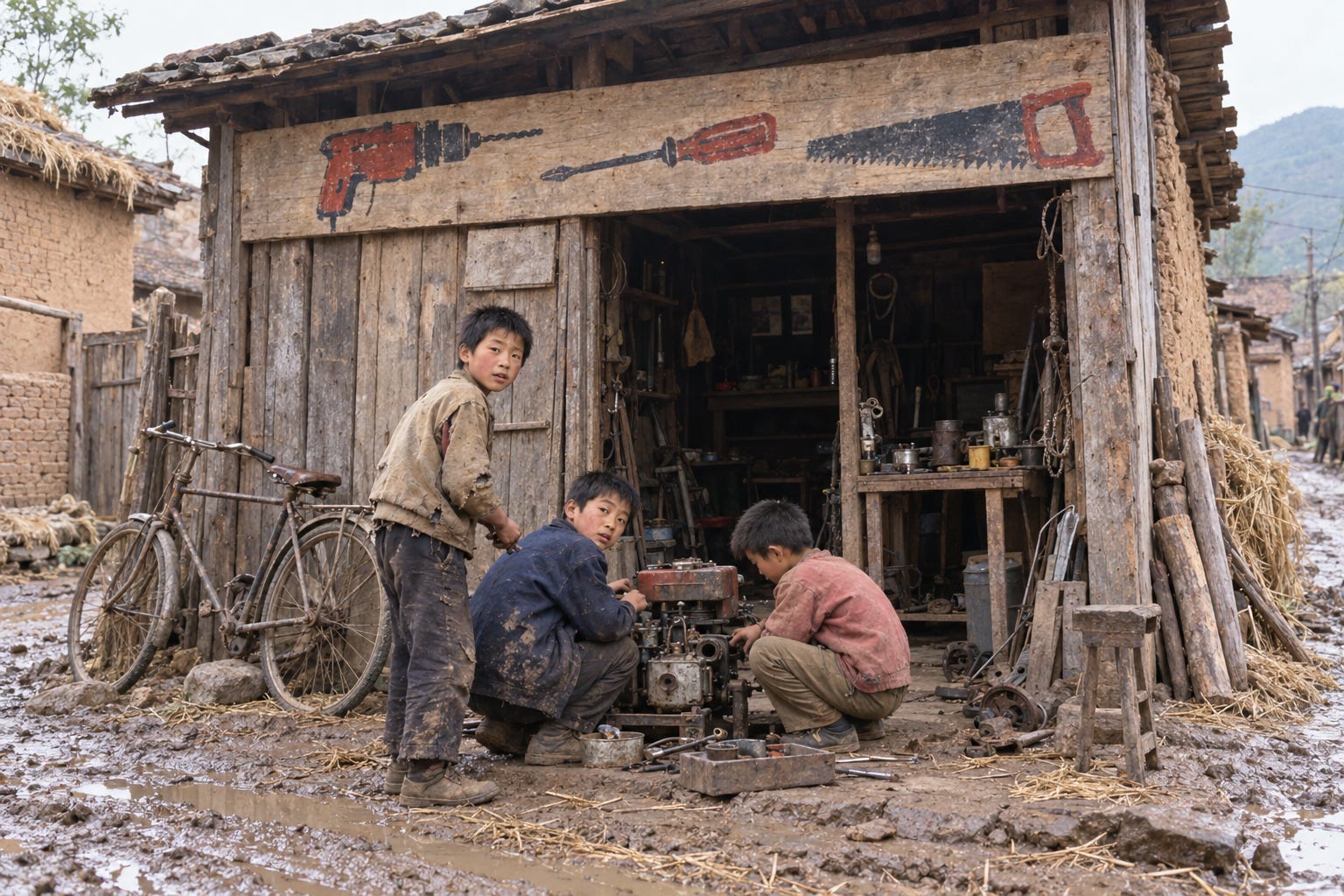
Chinese characters mark some stores, pictures others. A group of kids in tattered clothing work in front of a shop painted with a drill, a screwdriver, and a saw. They look up from the slow, concentrated task of putting some machine back together or, perhaps, taking it apart. What do they see? A white face, a leather jacket, jeans and boots, and a black license plate. They look for a long time before going back to their work.
Luckier kids walk past them on their way back to school after lunch. Boys with the shiniest black hair I’ve ever seen all wear red and white polyester athletic suits with bright green plastic rain boots to protect their feet from the mud. The girls, dressed identically, walk in their own groups. They wear their black hair in neat long ponytails with two or three bright-colored elastic bands. They turn at the sound of my engine but don’t stop walking or talking to their friends. They’re on a mission, unlike the kids who are working. I wonder if those are their younger brothers or sisters.
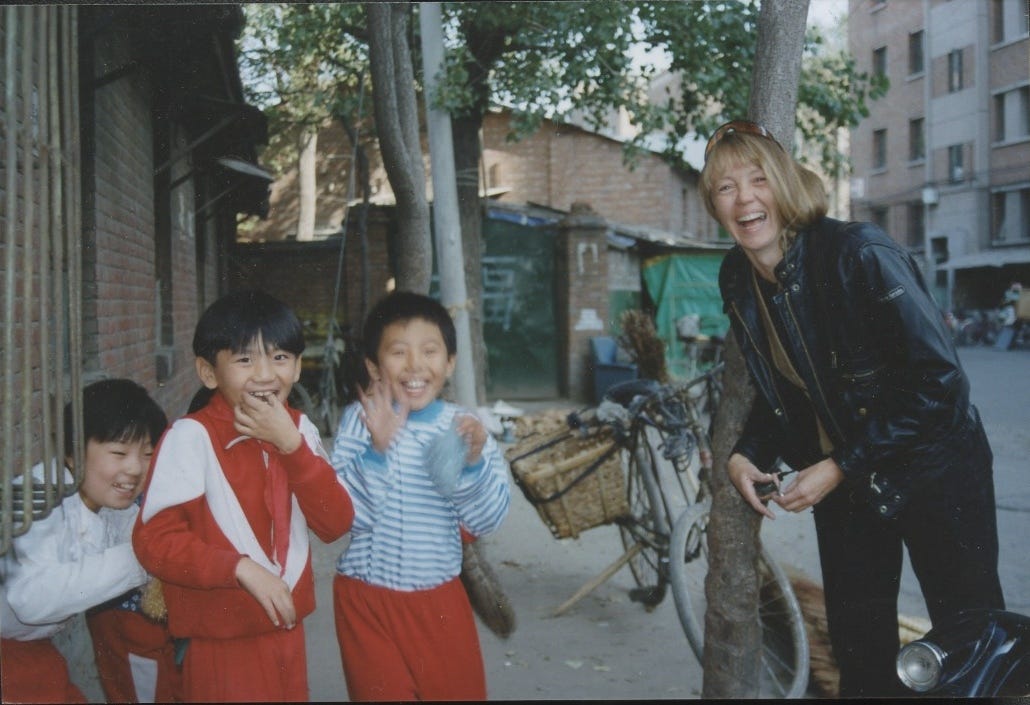
Teresa explained it to me in Beijing. As the embassy’s agricultural attaché, she spends her days asking farmers about their crops and their lives. Under Mao, she said, villages were organized into communes, and the commune paid for the village school. Around 1980, Deng Xiaoping’s reforms broke up the communes and handed the land back to families, and the collective money went with them. Now, in a country that still calls itself communist, peasants pay for school and medicine, and a lot of poor kids drop out to work.
The one-child policy, she said, is the same pendulum swinging back. Mao encouraged big families, and the population nearly doubled under him, so the leaders who came after slammed on the brakes. Many rural families are allowed a second child if the first is a girl, and others simply pay the fine. But an extra child may never be registered, and without registration there’s no school and no social services. The registration system itself dates from Mao’s time, built to keep peasants in their villages and out of the cities. If a family illegally moves to another town, they can’t register their children for school there either.
So what I’m seeing is an old communist method of control meeting a capitalist economy, with the old safety net gone and the new one not yet built. China’s new mobility is becoming complicated.
They’re caught in a system. But at home, under capitalism, kids get caught too. Here, I’m a foreigner passing through on a motorcycle, and I’m not sure anyone has the right answer.
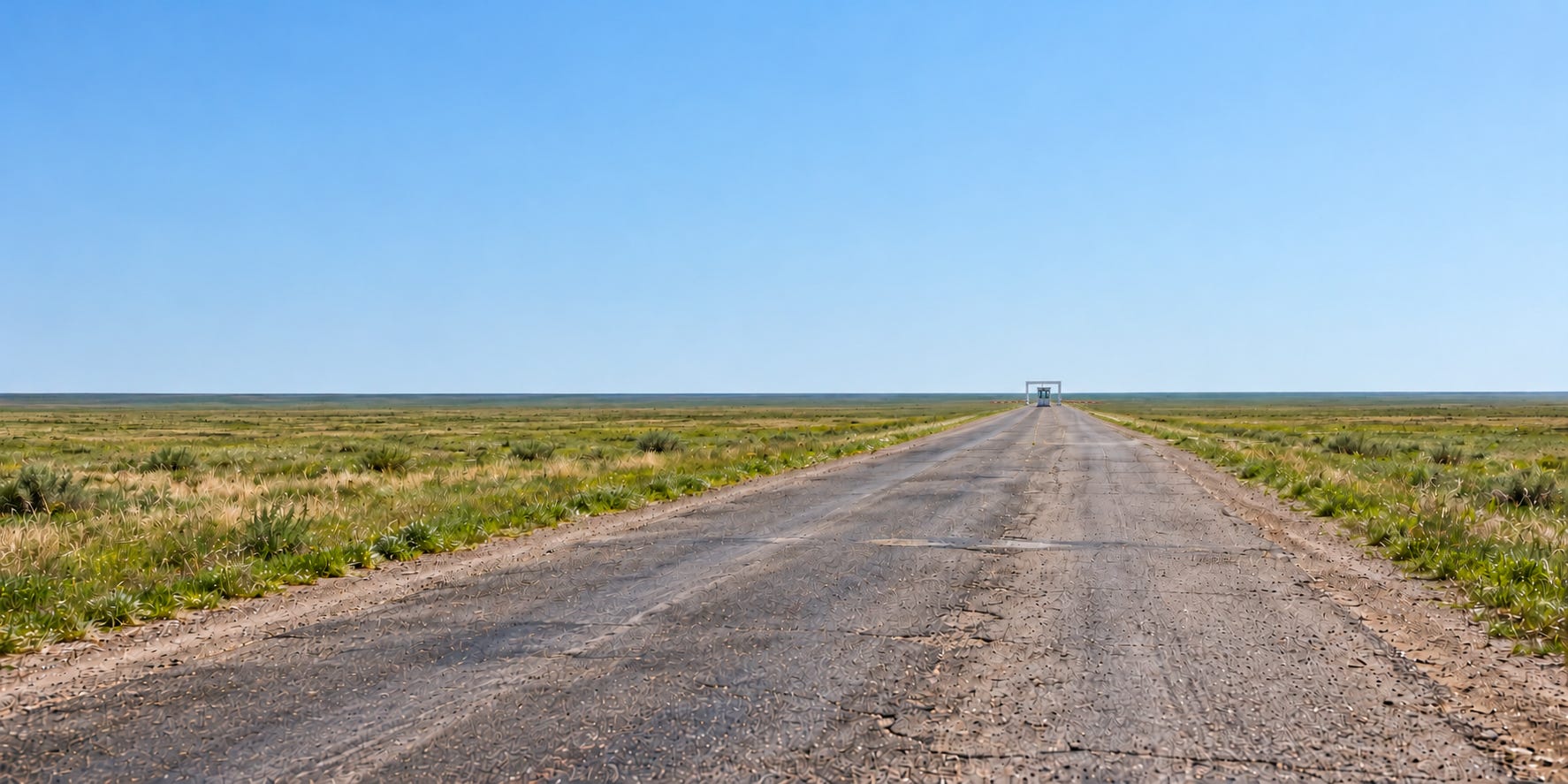
This problem occupies my mind as I ride on across the long flat windswept grassland past the occasional farmhouse. No towns appear for a long time, and then I spot a set of booths and a barrier across the road up ahead. What the...? My heart races. I hadn’t expected a border crossing. Maybe I shouldn’t have listened to those guys in the restaurant after all. It was a mistake coming into Inner Mongolia. I hadn’t studied it. Is it considered a different country, like Mongolia itself? I’ll certainly be turned back, or even put in jail. My documents will be checked and phone calls will be made. How do I feel about being turned back now? Well heck, I spent the night in a brothel and saw the Yungang Caves. That’s a lot of adventure so far, but I’m not ready, it’s not enough. I don’t want to go home yet, even if it might save my relationship. I shift into first, approaching the border as slowly as possible and trying to push everything out of my mind but the next few minutes.