

Welcome to The China Road Motorcycle Diaries—an adventure memoir in progress.
In 1998, before highways webbed the country and before China’s middle class filled the roads with cars, I rode an antique sidecar motorcycle alone across northern China—over provincial borders, into unsigned villages, through dust and doubt and long stretches of silence.
I’m publishing the book here as I write and revise it, one stretch of road at a time. Free subscribers can read selected chapters and follow the journey from a distance.
Monthly subscribers ($7/month) read the full manuscript-in-progress, join the chat, and take part in monthly live conversations as the book takes shape.
Annual supporters ($79/year) receive a special digital edition of the completed manuscript and access to live and recorded conversations.
Patrons ($179/annual) also receive a special-edition print copy of the finished book.
However you choose to be here, thank you. This story is being written in public. To receive new posts and support my work, please consider becoming a subscriber. Thank you!
Find the full table of contents here.
Chapter 10: Datong
Coal Dust and the Bù Bù Bù Hotel
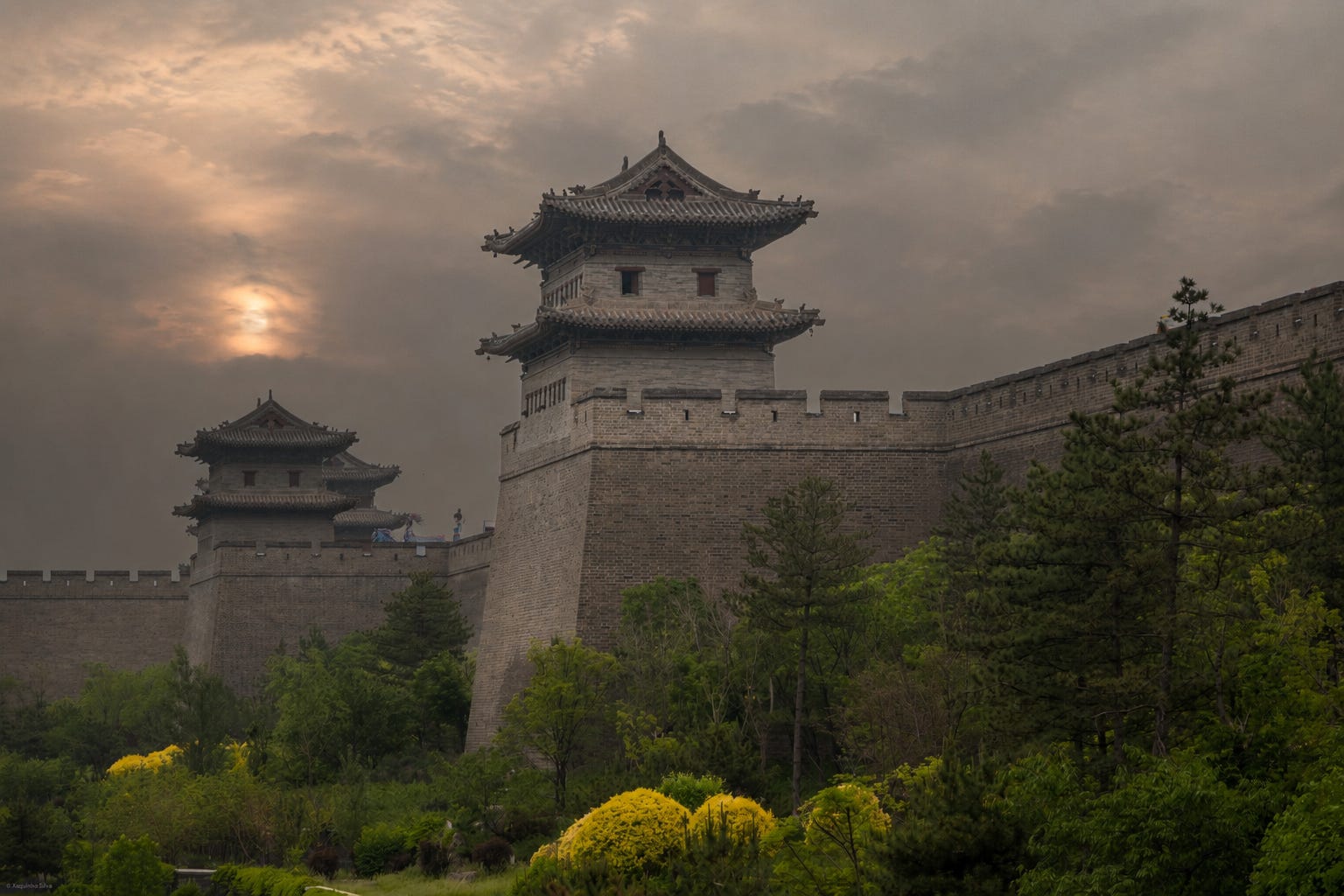
The tree-lined road leads straight to Datong where chimney stacks spew coal smoke forming a polluted dome that shines spectacularly red and yellow in the setting sun.
The Yungang Caves, my destination, is an hour north but the Lonely Planet guide says there is only one very expensive hotel there so recommends several budget choices in the city. This is fine, and why I love traveling with my own wheels. I am free to explore, to reach my destination, or to get terribly lost.
The guidebook had mentioned the air pollution in passing, focusing on Datong’s beautiful rammed earth walls, ancient city gates, a drum tower and a marketplace. In my opinion, the guidebook ought to have highlighted it with a red warning label. It hardly seems possible, but Datong is even more polluted than Beijing. After a few short minutes my skin is gritty with coal dust and my nostrils are nearly clogged with it. I try not to breathe through my mouth, but soon my nose is running and I’m sneezing like I have a cold.
The hotel I’ve aimed for is exactly where the Lonely Planet says it is, set off from the road by a huge parking lot enclosed by a chain link fence, with the complete absence of cars, scooters, or taxis. I chug across the lot paying no attention to the white markings meant to guide cars into each space.
Two men, uniformed brilliantly in red with lots of gold braid and gold tassels on their little round caps, stand by the porte-cochère, watching me closely, and suddenly sprint toward me waving and shouting. At first I think this is their special way of welcoming me, but soon realize that their hands make shooing movements. They are actually shouting at me to go away.
Confused, wondering if I in fact am in the wrong place, and as there is no word “Hotel” in Pinyin on the building, I can’t be sure. Still, I maneuver around them and roll up to the doorway anyway. I mean, what’s the harm?
I roll under the shade of the porte-cochère and suddenly they are all smiles. Perhaps they couldn’t imagine I was a guest, and a foreigner, too. At any rate, they start trying to help me with my bags, peeling back the cover on the sidecar.
Well good. It is a hotel after all. I let them know I’m not ready for the bags, and head inside to check the price, and to see if there’s an office service with a fax machine. I’m dying to do some writing, get some email, and post a story to my blog.
Inside, the lobby is enormous with high ceilings and chandeliers, its floor covered with a thin red carpet, lined by a mezzanine with a dozen little shops.
The marble registration counter is staffed by three uniformed attendants. We exchange formal greetings, and all the staff gather around. The young woman shuffles through some papers, and a man with a red badge approaches to supply her with a registration form from the sheaf of papers in his hands.
To my surprise and delight, the form is in both Pinyin and Chinese. Remembering my ordeal of the previous night, I seize the moment, and request a second form. The young woman shakes her head emphatically no, and comes around the counter to stand next to me.
“Bù hǎoyìsi,” she says, the polite way of saying, sorry, but no.
I hold the paper to my chest and turn to her manager, who also shakes his head emphatically no. But there they are, several copies in his hand, right next to me. I deftly pluck one from the manager’s grasp and try to put it in my bag but the woman quickly snatches it back. I insist, smiling and shaking heads and pointing at the paper and my dictionary.
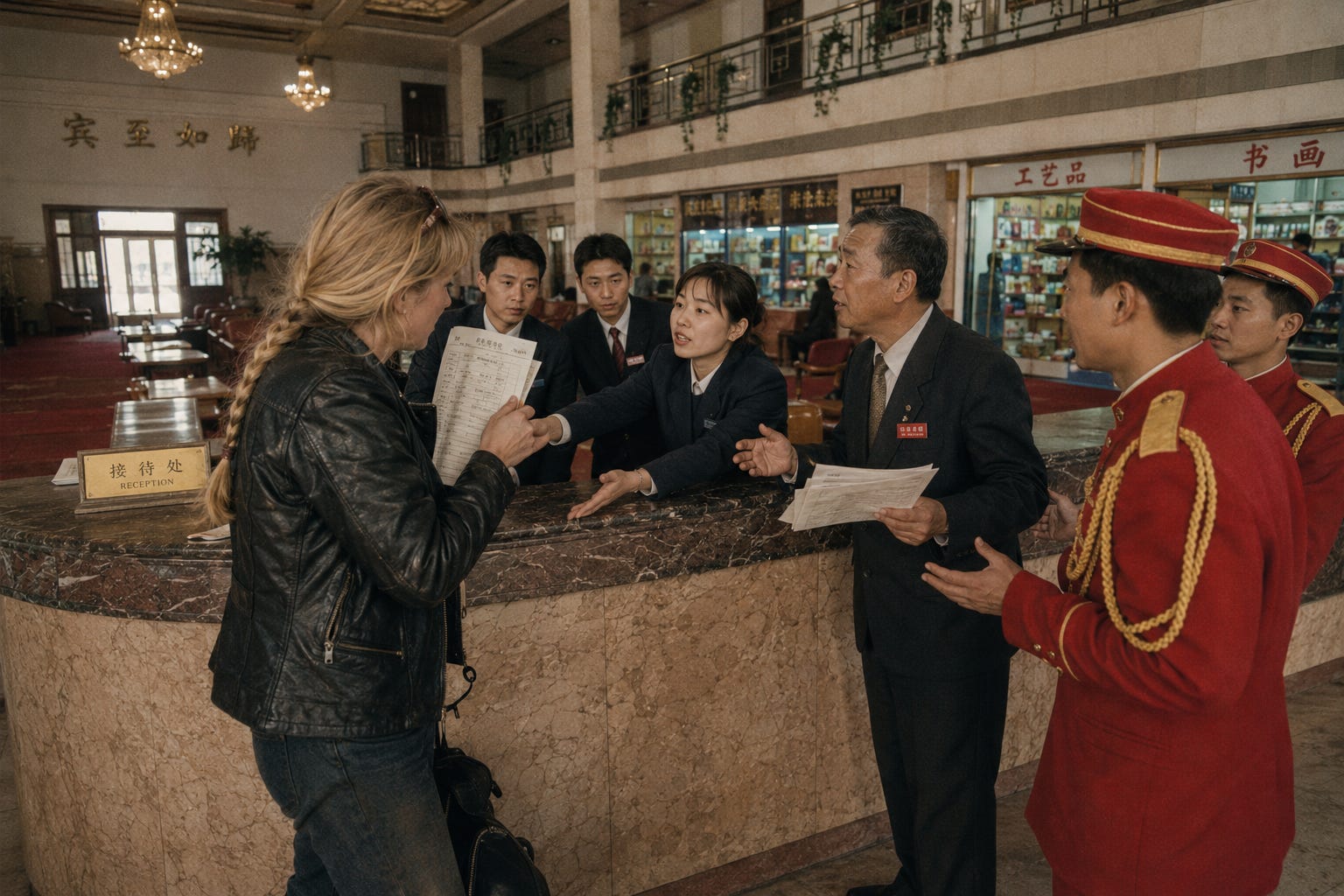
Suddenly, everyone is talking.
“Bù. Bù xíng,” says the young woman, shaking her head. No. Not allowed.
The manager and the bellmen join in with variations of the word no.
“Bù hǎoyìsi, bù xíng,” means sorry, that’s not possible, an especially popular phrase I’ve encountered more than I’ve liked. I learned it when I was trying to get legal permission to tour the country. But here I am anyway, despite the risk of getting caught and kicked out.
“Bù,” they all say, nodding their heads no and then yes, until we are all just bobbling our heads around.
“Yào,” I say, which is all I can remember at the moment. It means need, and I use it with my most pitiful beseeching voice.
But it’s all “Bù bù bù.”
They shrug, shake their heads, and open their hands palms out, to show it’s not possible. They talk among themselves, a lot of chatter I cannot understand except more bù.
I offer coins.
They laugh, but keep shaking their heads. “Bù bù bù.”
The young woman gestures, waves the paper around as she talks, and I don’t know what comes over me, but I just snatch it and quickly stuff it in my bag.
Everybody stops talking, stops moving.
“Xièxiè xièxiè,” I say. Thank you thank you.
This brings on another barrage of bù bù bù. But I play dumb, calm, bowing a little.
“Xièxiè,” I repeat. Smiling, I hold out the coins again.
“Bù bù bù.”
And then finally they give up. Less “The customer is always right” than “Possession is 9/10ths of the law,” I figure, and they cannot possibly have a foreigner in the hotel without an accompanying form.
Thanks to the Pinyin translation, the form is completed in no time. Back outside, I stack the bags I want in a pile and park the bike where they tell me: not in one of the perfectly-marked spots meant for cars, but around the side, next to the bicycles.
Unlocking the trunk, I carry my laptop and camera myself and follow the bellmen, in their bright red and gold uniforms, into the elevator. The door slides open onto the fourth floor hallway where a scowling old woman behind a large wooden desk guards a rack of keys neatly tucked into cubbyholes built into the shelves behind her.
She and the bellman have a conversation. She looks ready to say bù at every request and is probably scowling because she expects, correctly, that I will require higher maintenance than the typical Chinese guest, more towels and extra toilet paper. I know from my visit last year that Chinese hotels eke out toilet paper like it’s made of money.
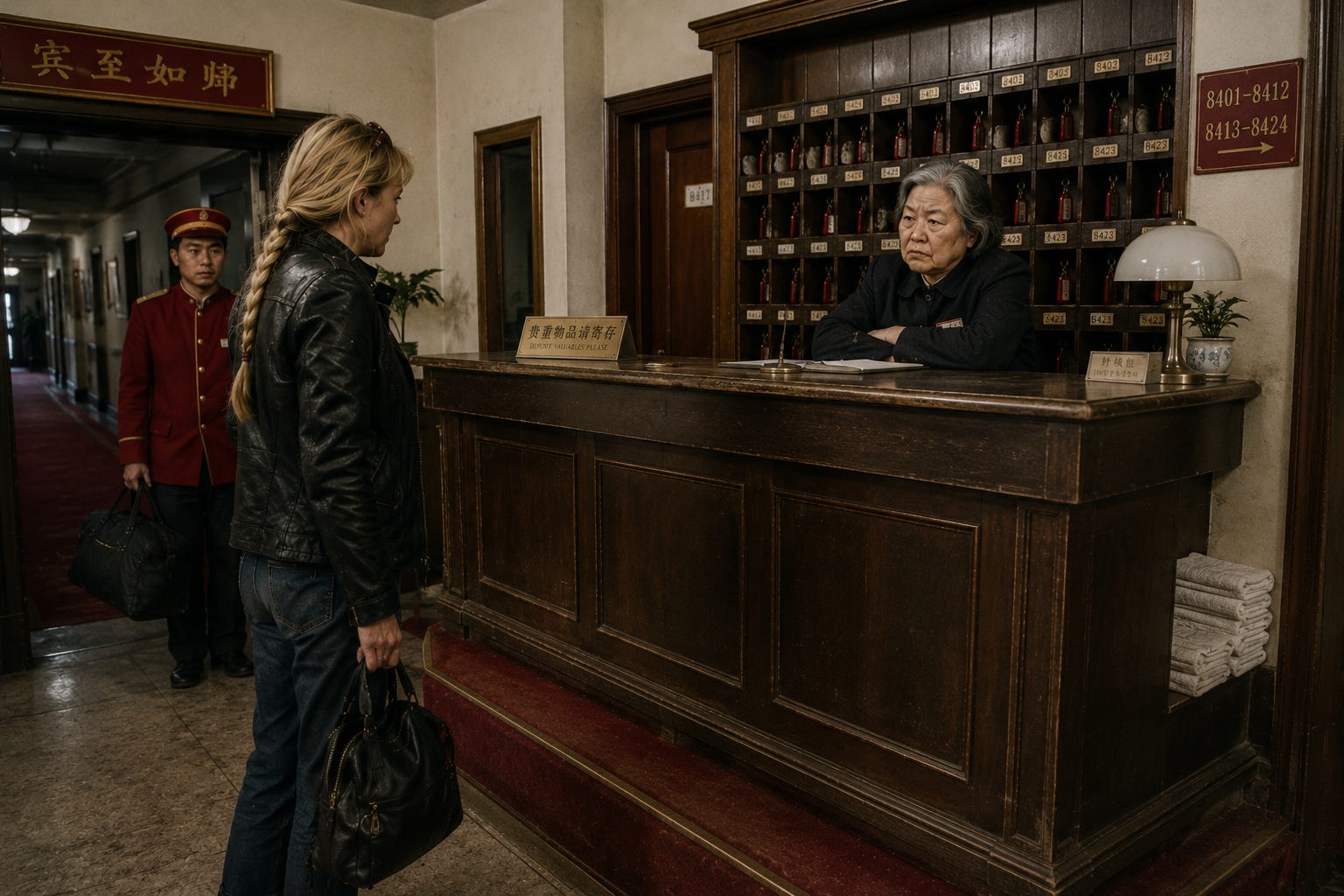
Reluctantly, and with much discussion, she hands the key to the bellman and glares at me before I follow him to the door. After he opens it I hold out my hand for the key, but he clutches it to his chest.
“Oh no, wait. I don’t get the key?” I say this in English, more to myself than to him.
