

Welcome to The China Road Motorcycle Diaries—an adventure memoir in progress.
In 1998, before highways webbed the country and before China’s middle class filled the roads with cars, I rode an antique sidecar motorcycle alone across northern China—over provincial borders, into unsigned villages, through dust and doubt and long stretches of silence.
I’m publishing the book here as I write and revise it, one stretch of road at a time. Free subscribers can read selected chapters and follow the journey from a distance.
Monthly subscribers ($7/month) read the full manuscript-in-progress, join the chat, and take part in monthly live conversations as the book takes shape.
Annual supporters ($79/year) receive a special digital edition of the completed manuscript and access to live and recorded conversations.
Patrons ($179/annual) also receive a special-edition print copy of the finished book.
However you choose to be here, thank you. This story is being written in public. To receive new posts and support my work, please consider becoming a subscriber. Thank you!
Find the full table of contents here.
Author’s note: Some of you have been asking: what makes you want to do this kind of thing? What are you thinking when you’re alone and something goes wrong? Don’t you miss home? I hope this chapter answers some of those questions. Please leave your comments and questions at the bottom. I’d love to hear them.
To refresh your memory: this is only my second day on the road, but already it’s been a week’s worth of adventure:getting lost, riding in the dark, nearly hitting a family of pigs, spending the night in what turned out to be a brothel. This chapter picks up where I left off, after two men in a mountain restaurant convinced me to abandon the back roads and head toward Datong and the Yellow River instead. (They may or may not have been Chinese mob. I’ll let you decide.)
Not a subscriber? For the price of a latte a month, you get access to all the chapters. I appreciate your support.
Chapter 9: The Road to Datong
Yīlù Píng’ān (One Road, Peace All the Way)
Finally, traffic starts to move. The men have places to go, people to see, and with regretful smiles, we stand and formally shake hands. “Datong,” one of them says, with purposeful eye contact as if to hypnotize me into agreeing with him. When I say “okay,” they giggle like boys then morph back into the serious men they are.
The proprietor hurries to hold the door. Xièxie, he says, nodding in respect as the men stride out in their fine suits and designer sunglasses. They disappear behind the tinted windows and the sleek vehicle glides into traffic like a shark in the reef, the candy-colored cars scattering to make way.
Bang bang.
I am truly tired of the mountains. All the twists and turns have made my muscles sore. I don’t worry about my safety, but the scarcity of road signs and reliable accommodation is stressful. At home, friends, family, even strangers worry about robbery, rape, kidnapping, but they haven’t traveled as I have. I’m not just a tourist, I’m on a motorcycle, and the motorcycle is a power symbol. I experienced this phenomenon on my first solo journey in France. There is an impression that the rider is capable and experienced, anything but the usual wandering traveler that might easily be taken advantage of. And here, my high-visibility foreignness is a protective cloak. As my friends in Beijing put it, I’m leaving a wake behind me. Even if I get lost, everyone else knows where I am. It’s discomfiting and reassuring at the same time.
I linger to consider the new plan without the influence of the bang bang guys, referring to what I now know is an untrustworthy map, along with the slim and outdated facts in the Lonely Planet, published before the recent shift. Okay then. Enough with the mountains. For now, at least, I’ll head to Datong and visit the nearby Yungang Buddhist Caves, then ride along the Yellow River and, looking at the map, that will bring me near Inner Mongolia, which I hadn’t thought to explore. There’s plenty of time, I remind myself, and if I find a new homogeny, if villages have been replaced by factory towns and apartment buildings, I can always turn inland again.
Packing up my things, I stop to pay my check. But the proprietor shakes his head and tells me my companions have already taken care of it. It’s a sweet surprise, and I smile as he bows and wishes me yīlù píng'ān, one road, peace all the way.
Back on the bike, I think about tomorrow, my fortieth birthday. The Yungang Caves seem like a good place to spend it.
Down the mountain the landscape opens to a plateau of deep gold, soft-looking, windswept, almost lunar in its bareness. This is loess: fine dust, carried here by the wind out of the western deserts to settle in layers over hundreds of thousands of years. The dust settled and built itself into hills two hundred feet thick in places, and once it was forests, grasslands, with soil rich enough to have fed the first Chinese dynasties. But the trees came down centuries ago, cut for fuel and farmland, and without roots to hold it, the loess has been sliding away ever since, gully by gully, rainstorm by rainstorm, into its namesake Yellow River that carries its color all the way to the sea.
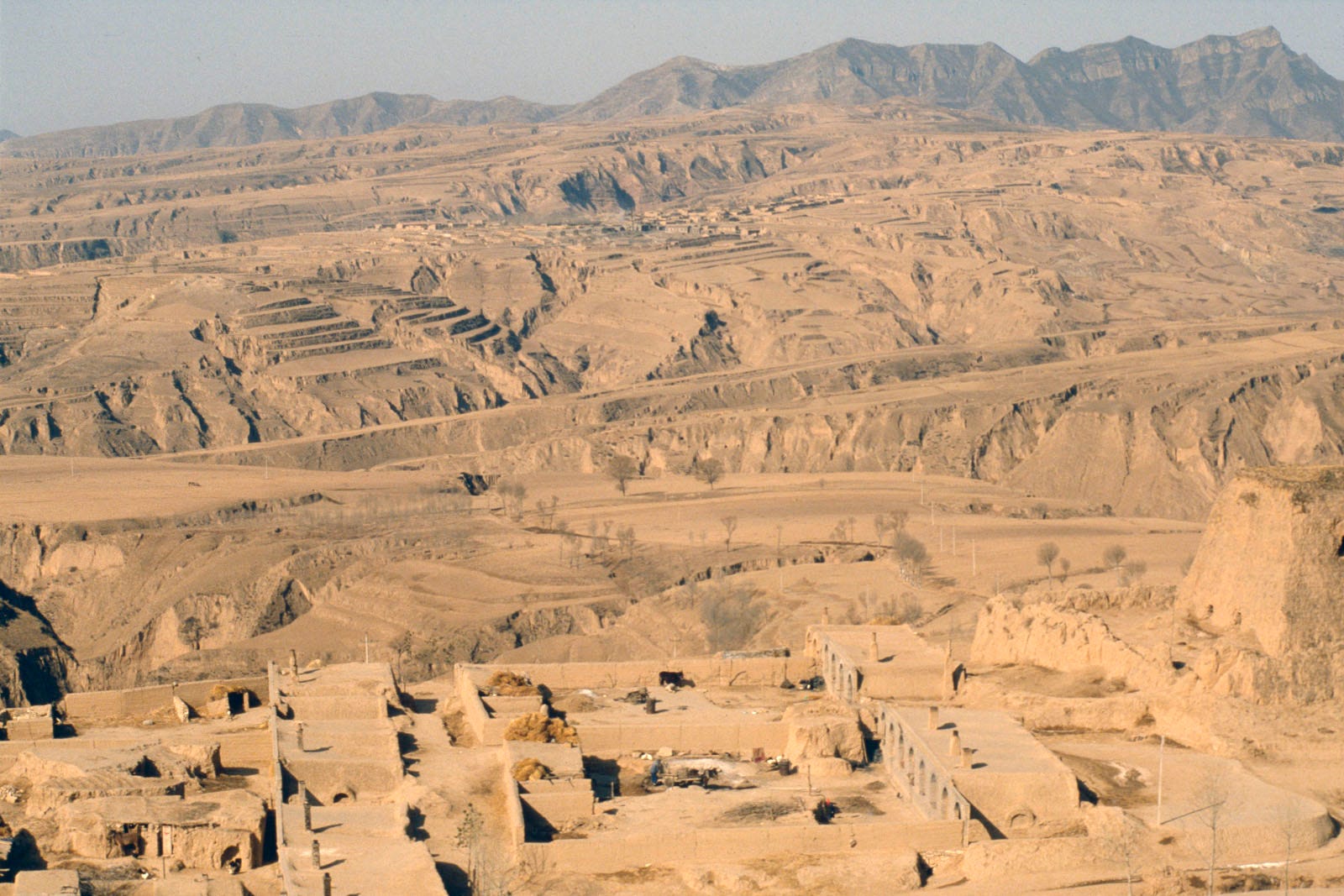
The road is good and I’m flying along, if 40 mph can be called flying, but compared to the last couple of days it seems fast and free. Wow, I’m here, in China I think to myself, and I spent last night in a brothel. Did I? It seems unreal. It seems like last week. Not like yesterday. Not like this morning. I want to tell somebody, but then again, this living in the present, in the now, feels priceless, free. For a moment my mind shifts to home where Ram Dass’s book Be Here Now sits on one of our many bookshelves.
As usual, while traveling, I’ve been too busy, too immersed in taking things in to think about home or anything that doesn’t have to do with the here and now. With my mind looping on essentials like gas, food, and shelter, the state of being absolutely 100% present is effortless.
At home, I can get close to emptying my mind by riding over the Golden Gate Bridge with no particular destination in mind. My thoughts are only on the road, attuned to other drivers, the weather, the new cafe or fruit stand, the pullout at Jenner where you can watch the sea lions frolicking in the Russian River where it flows into the ocean. I almost always end up in Bodega Bay before looping home on the Bohemian Highway, stopping at Wild Flour Bread or the Fairfax Scoop. Yet there’s still room left over in my head to remember I need to pick up toothpaste and coffee filters on the way home, or to loop on triviality that won’t matter by next week.
Here, there’s no room for any of that. Everything has higher stakes. Will there be gas, food, a decent place to stay? I’m not in a constant state of alarm, but a kind of hyper-awareness, senses wide open, that’s become my best traveling companion. It’s the sixth sense, the thing I can’t quite explain, that years of solo travel have taught me to trust over everything, even reason. This sense tells me where to go and where not to, who to trust and who not to. My mind isn’t cluttered with trivia. I’m just here, now, in the middle of all of it when I see a sign and a guard shack standing at the entrance to a big empty parking lot. It must be a tourist site, getting ready to accommodate all the drivers in all the new cars.
Slowing, I see nothing but a cliff face that rises from the ground about 300 feet away. I slow further, my eyes searching for the reason for this brand new parking lot, and finally notice a man-made structure about 100 feet up. Stopping now, the engine idling, I see it’s a temple, or at least the front of a temple, or several temples, pasted onto the cliff face. They’re painted red with the traditional curlicue tiled roofs; but wait, are those bridges that connect the various buildings? They are. But how would one manage to get up there? My eyes straining to find a path, yes, there is a narrow staircase hewn from the cliff.
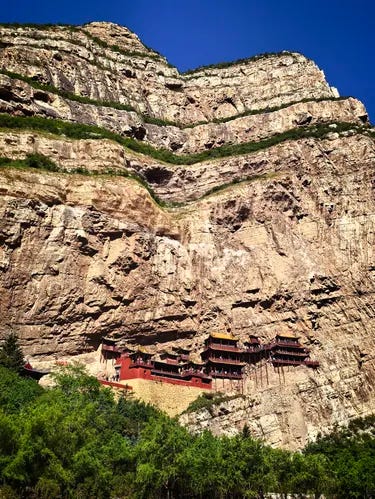
I'm dying to see it, but it's closed. The low fence around the lot and the sagging chain at the entrance prevent me from riding in. The guard shack, also new, with clean glass on four sides, stands empty. A large sign faces the road in bold red characters I cannot read. Opening soon, perhaps. Or the name of the site, and the ministry responsible for it, and nothing else. There is no way to know. In fact, the parking lot is so black, so smooth, so clean that I wonder if it has just been paved in preparation for all the new visitors with all their new cars.
I can’t quit so easily. Maybe if I get off the bike to walk across to the cliff someone will be there, and if not, I might just walk up those stairs anyway. It could be abandoned, or a guard might be napping there. I think the bike will be safe where it is.
I reach for the ignition key to turn off the engine and grab empty air. The key is gone. Gone. It takes me a moment.
The motorcycle is still running, but there’s no key.
Okay, it must have vibrated out. How stupid, I think. Just absolutely the dumbest thing. The bike is a rattletrap and of course the key would wobble out. I should have attached it to a string on the handlebars, but I didn’t, and now it’s gone.
But maybe it just happened now. I search around the bike. Under it. Nope. Undoubtedly, it is on the road, mashed by a tire, or bounced into a ditch. I can’t go back. I don’t want to arrive in Datong in the dark. I shudder, remembering the cold, dark roads. After yesterday, I do not want to ride in the dark ever again.
And what if the engine stalls? If I were on a hill, I could roll-start it. But it’s flat here, and I can’t push 800 pounds. The only option is to ride on and hope to find a locksmith.
How do you say “locksmith” in Mandarin? I open the trunk to find the parts and phrases list Jim had written out to make it easier for me to communicate with shopkeepers and mechanics. He wrote out the words in Pinyin and Chinese characters: oil, chain, piston, brake pad, brake lever, throttle lever, valve adjustment, tire, spokes, headlight. I turn the pages. It provides every directive, every part, except ignition and key.
I grab my dictionary and find all the words: Lock. Key. Ignition.
Suǒ. Yàoshi. Diǎnhuǒ kāiguān.
There’s nothing else to do but to keep going and hope and practice the words in my head as I ride, guessing at the intonation.
Suǒ. Yàoshi. Diǎnhuǒ kāiguān.
Every once in a while, I glance down at the ignition cylinder. With the loss of the key, I’ve also lost the little rave toy fob Michael gave me before I left, a silly little spaceship keychain, bright orange and green with a fringy tassel that was already getting grimy. The funny little memento had made me think of home.
It’s Sunday in San Francisco, I remember, so we’d likely be at a party or sleeping off one, having spent hours in a warehouse full of music and dancing and art and all the elaborate trimmings of the scene Michael lived for. As a popular event producer and deejay with an innate sense of how to rev up the dancers, he surprised and delighted the much younger party goers, his long graying hair becoming iconic in the scene. He was dubbed DJ Goz (short for his last name, Gosney), and rumors of his appearance were enough to bring a good crowd.
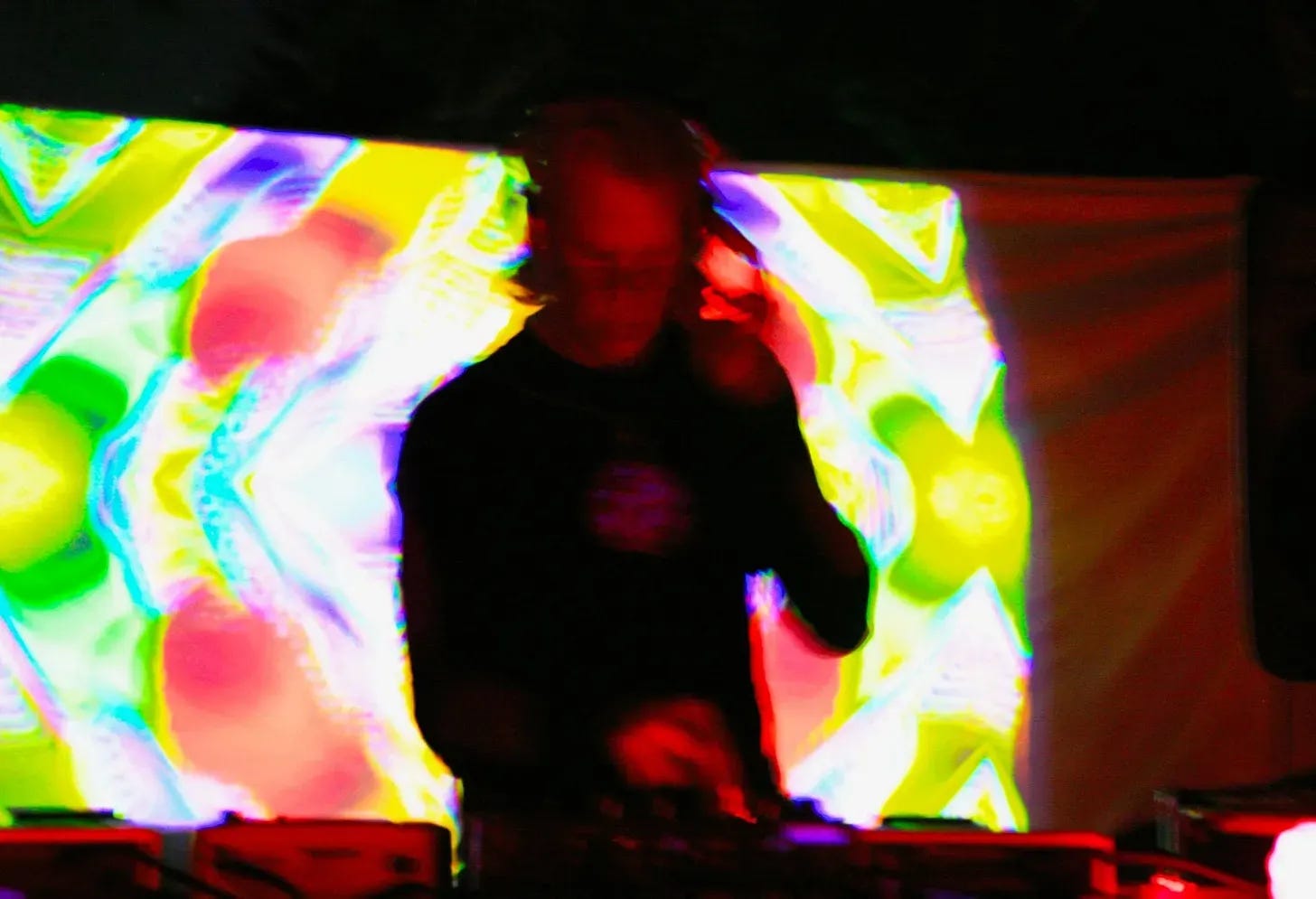
The psychedelics had done their job for me. I’d fired those synapses enough times to know what they had to show me, and though the pull was still there, I could sense it wasn’t healthy to keep going back. More often now I’d skip the parties in favor of an early morning on Mount Tam, a bicycle ride to Sausalito, or point my motorcycle to Skyline Boulevard. I’d come home to find Michael asleep, hoping he’d tire of it, too, yet knowing he was becoming more and more involved in event production and electronic music, and wondering what that meant for our future.
Suǒ. Yàoshi. Diǎnhuǒ kāiguān.
Chanting my words, I observe the stark beauty of the windswept yellow cliffs as I ride through in the sun and the warm air, sad to have missed seeing the cliff temple, but happy in my way, despite my worries. I can push start it, with help. Or hotwire it. It shouldn’t be that complicated.
The road narrows and rises to a higher plateau with low, yellow loess cliffs along each side of the road. The afternoon sun lights up the eastern-facing cliffs which feel like a wasteland, remote, empty, abandoned.
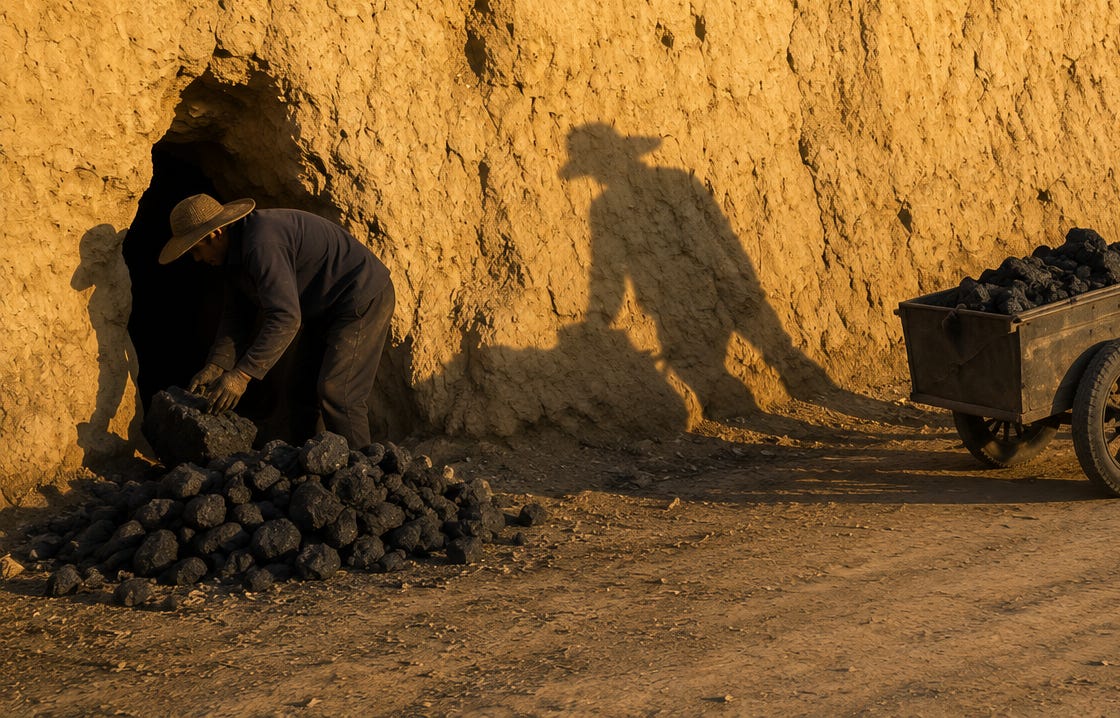
But then I see movement, a man, or a black silhouette of a man, who seems to be walking out of the cliff. Slowing down to look for the crevice or canyon he appeared from, I realize that he’s wormed his way out a hole. A literal hole, barely big enough for him to crawl into. A pile of coal chunks sits at the opening of the hole, and the man is not silhouetted, he is black like a shadow from his face to his shoes. I am too far away to see anything but the hole, the pile of coal pieces, and the coal black shadow man.
Then another man appears, pulling a wheelbarrow, stopping at another hole. And another. And then another man emerges. They speak, then continue their work.
Idling, I contemplate these men and their work. It looks dangerous. The hole could collapse. They are breathing coal dust. A cloud passes and the sun shines upon them, creating shadows from shadows, silhouettes from silhouettes, sharp like cutouts, that mimic their movements against the golden cliffs.
I pull over, idling, making sure not to stall because of the key, yet knowing I could turn the bike around and push start it from the hill.
The man with the wheelbarrow nods and goes on his way, bends, picks up chunks of coal from the pile, and moves on to the next, a wide-brimmed hat sheltering him from the afternoon sun.
I put the bike into gear again and motor on for miles and miles of the same yellow landscape.
And then, out of nowhere, a marketplace. My heart soars, then drops into my stomach. Do I dare hope? Slowing, the engine chugs along as I search among the tables. It’s like a flea market, a disorganized jumble of food and plastic goods and oh my god, tools and wheels and mechanical things set up on flattened cardboard boxes and folding card tables.
Cruising slowly along, I am dazzled, hopeful, yet not yet willing to believe my extreme good luck. I spot a teenager repairing a tire and head toward him. He jumps up excitedly when he sees me. He wears greasy blue pants, two sizes too large and cinched around the waist with a rope. Clearly, he’s thrilled to see a foreigner. When I point to my missing ignition key, he says, “No problem!” or at least it sounds like he’s saying that, and waves me on down the line, shouting to a woman selling pot stickers who, in turn, shouts at someone else farther down and so on until I reach an elderly Mao-blue clad man sitting on a stool next to a wobbly aluminum card table surrounded with boxes of all sizes. The young man in the chain of guides who has led me here shouts and picks up a box, opens it, and shows me the keys. Many keys. A locksmith.
This is unreal. I do not know who to thank. It’s like this place appeared because I needed it. Could there be such a coincidence? Such magic?
Grinning, I click the bike into neutral and leave it running as the old locksmith hobbles over to me. Suddenly, I’ve lost the words for lock and key and ignition, but there is no need.
“Qǐng, xiānsheng?“ I say, the phrase for please, mister. I point dumbly at where the key ought to be.
With the gravity of long experience, the man studies the ignition cylinder and hobbles back to his table. Among the hundred, literally a hundred unmarked boxes on and under and around his table, he selects three.
Impossible, I think, looking around for his tools. There’s no key cutter, no grinder, no generator to run them. Maybe he’ll use a file, I think, once he finds a key that will fit.
The boxes are all small, about six by eight inches, made of heavy cardboard in white, gray, and brown, streaked and dusty with frayed corners. As he picks through their contents, I think, this is too much. This is just silly. And how is he going to match the key without having the original to compare it with? I set the foot brake, leave the bike running, and walk to his table.
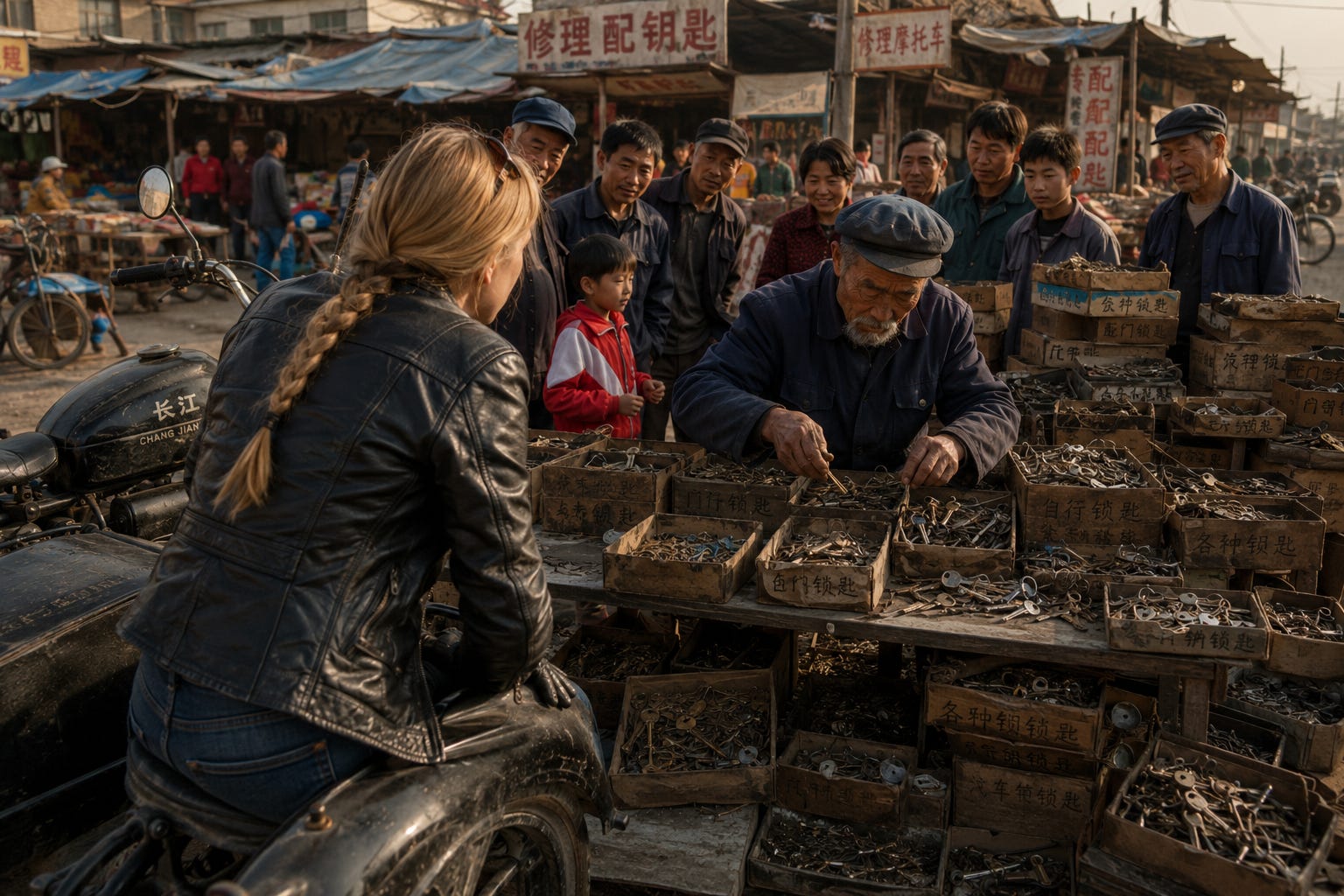
Inside each of the boxes are twenty to a hundred keys. They are sorted by size but in many different kinds of metal and shapes. Some of them are rusty or corroded and there’s a significant amount of dirt, metal filings, and even some nuts and bolts lying among them. A metallic scent rises as he scatters the keys with his leather-thick fingers, which are stained gray and blue with metal shavings. The metallic scent mixes with the dust of the road, chalk, coal, soy sauce, grease, onions, and something pungent, like ginger and red peppers.
Around us, other vendors are doing business as best they can with the distraction of a real live lǎowài in their midst. I feel them watching but they don’t crowd us, perhaps out of respect for the elderly locksmith.
The locksmith, after selecting four or five keys, turns to my bike. I stare, hopeful but tense, as he tries one, then another.
The third one fits.
My level of astonishment is so great that I can barely respond other than holding out a handful of small bills and coins. He picks out the correct amount—much too little. Fifty cents worth, perhaps. I hand him a few more bills, about two dollars’ worth, saying xièxiè, xiānsheng, xièxiè, but he just smiles a toothless smile and wags his head.
But I can’t possibly leave without thanking him more, he can’t realize how important this is to me. In his world, this may happen all the time, but in my world, keys just don’t fall out of ignitions and locksmiths don’t just appear when you need them.
He refuses more money and, distraught, I remember my stash of souvenirs to give away, tiny flashlights and keychains with scenes of San Francisco. Perfect! Rummaging through the gray duffel in the sidecar I find my bag of trinkets, choosing a keychain with a scene of the Golden Gate Bridge, brilliant and sparkling in Plexiglas.
He accepts it tentatively, with curiosity, turning it around and around in his leathery hands, the smooth shiny object looking as foreign as a spaceship, like the spaceship fob from Michael I just lost.
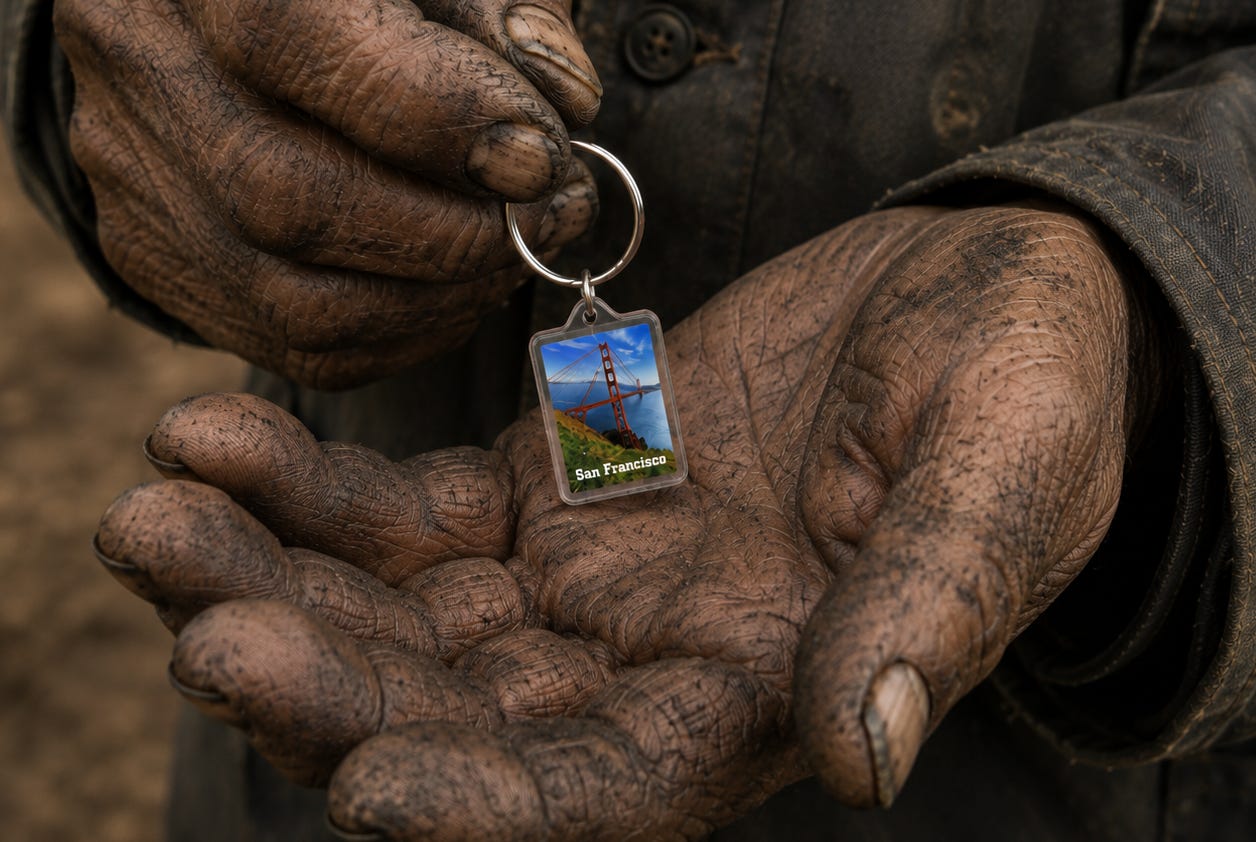
The locksmith inspects the keychain so thoroughly that now I realize he has no idea what it is. He’s unlikely to have ever seen the Golden Gate Bridge, even in pictures, and has probably never heard of San Francisco. It’s pleasing, though, and finally, he nods and smiles. And I feel better to have given him something, and maybe someone who knows about it will come along and tell him what it is.
I ride off in a daze, still unwilling to believe my good luck, and it’s not until miles later I realize I ought to have asked him to make me a spare.
I have also forgotten how I lost the original key. I glance down to see the new one vibrating in the cylinder. What a fool I am.
Pulling over, I put the bike in neutral and set the foot brake. There must be a string somewhere, a shoelace, something, but I can’t find it so, for now, baling wire will have to do. I twist one end of the flexible wire around the key and the other to the handlebars. It’s not an elegant tether, but it’ll do for now.
Thanks for reading this chapter of the China Road Motorcycle Diaries, an adventure memoir in progress. Here’s a note about how this area has transformed.
When I’m finished publishing this beta book here on Substack, I’ll release it as an ebook and print book as well. So I’d love to hear your comments about the story—your impressions, your critiques, to make the book the best it can be. Just click the red LEAVE A COMMENT button here.
Thanks so much!
Find the China Road Motorcycle Diaries table of contents here.
Know someone who may enjoy these stories? Share the publication here:
Your writing takes me there! I lived and worked in China from 1984-87 so I know of what you write. I am impressed that you rode a motorcycle. We rode Chinese bikes and got around pretty well locally, but took trains for longer trips. Our son was 2 years old when we arrived. Loved the photo of the locksmith holding the Golden Gate trinket! He was your golden gate or perhaps golden key!